
Invitation to Tender

The activities at this stage must be carefully managed to support the Principles of Procurement.

As a minimum processes must be undertaken in a transparent manner,  ensuring no market place distortion.

The procurement process cannot unduly favour or disadvantage a supplier. It is your responsibility to ensure these requirements are met. 

Access to the ITT and any related documents should be non-discriminatory, generally available and free of charge.

Quickfire Guide

Quickfire Guide

Invitation to Tender Document Contents

A quickfire guide for the sections you should include in your ITT, where relevant to your procurement.

Availability of Invitation to Tender Documents

When using a two stage process, documents will only be made available to bidders who have passed the selection stage.  Invitations to submit a tender should be issued simultaneously to all bidders and in writing. 

If you are not using a separate selection stage, ITTs should be issued on request to any interested supplier.  This can be at any point prior to the tender submission date set.

Where ITT documents cannot be issued electronically (for example because the information is sensitive or the contract is of a nature that requires specialised tools and/or files) then you can use other means to issue the documents. If you do this, it would be good practice to increase the tender time limit by five working days to allow for this extra process.

Evaluation Criteria, including Financial Criteria

The evaluation criteria and weightings must be published within the Contract Notice. For more information refer to Selection, Award & Exclusion.

Price/financial evaluation criteria should include:

  • Whole Life Cost comparisons
  • Quantifiable financial benefits arising from the technical evaluation (e.g. speed, fuel or electricity consumption, coverage, shelf life, etc.)
  • Fixed or variable pricing
  • Cost of components, spare parts, consumables and servicing
  • Life-cycle costing where appropriate. 
  • Risk analysis and financial appraisal (for major contracts of strategic importance, especially those of an innovative nature).

To support this process, as you are developing the documentation you will draw information from the Develop Strategy stage of the Procurement Journey. 

It is best practice to agree the evaluation criteria with the User Intelligence Group (UIG). These criteria will identify which eligible tenderer(s) will deliver best value for money for the organisation, based on the Most Economically Advantageous Tender (MEAT).

You should identify the Most Economically Advantageous Tender, assessed on the criteria linked to the contract's subject matter.  This should include price or cost evaluation using a cost effectiveness approach.  A cost effectiveness approach may include Life Cycle Impact Mapping

It is important to differentiate between Whole Life Costing and Life Cycle Costing  and further information on both an be found in Additional Resources.

Lifecycle Impact Mapping

Focuses on social and environmental impact rather than cost.

Life-cycle impact mapping helps you identify and assess impacts. For example, you may focus attention on the disposal phase before beginning the procurement.  This then allows you  to build end-of-life management requirements into performance clauses and internal management procedures.

Please note:  Life-cycle impact mapping can be used alongside life-cycle costing as part of the procurement process.

Other considerations for ITT documentation

You may wish to consider the areas below for inclusion within the ITT documentation:

  • e-Commerce: e-Capability, e-Procurement Information, e-Auctions, etc.
  • Contract implementation/contract and supplier management information
  • Proposed implementation plan
  • Management information - requirement to provide line item detail
  • Roles & Responsibilities
  • Key Performance Indicators (KPIs)
  • Mini-competition guidance: details of process to be followed for call offs


Invitation to Tender

The ITT or the Invitation to Confirm Interest should include comprehensive information for potential bidders about the requirement being tendered. While there are a number of Generic Documents listed below that will require insertion into all packs (e.g. a reference to the relevant Contract Notice or Award Criteria weightings) some of the content will naturally be specific to each requirement and you should select those that you need to include in the ITT pack from the list below:

  • A reference to the relevant Contract Notice, previously published
  • Instructions to bidders including the tender submission deadline;  address to which the tender submission is to be sent and the language which the tender submission must be submitted in
  • It is good practice to issue an SPD to bidders.  For more information, please refer to Selection Criteria and SPD
  • Award Criteria weightings
  • For services contracts, if deemed applicable, you should ask the bidders to indicate any share of the contract that the tenderer may subcontract and information about the subcontractors including their name and contact details.  You may request separate SPD responses from subcontractors and consortium members, when deemed appropriate, in order to safeguard the effective delivery of the contract, based on relevance and proportionality to the contract
  • For contracts which may be extended, the nature, quantity and, where possible, the estimated time for exercising options
  • For supply or service contracts, the nature, quantity and, where possible, estimated publication dates of notices of future tenders
  • If applicable to the contract, the delivery of supplies commencement or termination date(s)
  • The address of the Organisation who will award the contract
  • Economic and technical conditions, financial guarantees and any information required from bidders
  • The form of the contract to be used e.g. purchase, lease, hire-purchase, or a combination
  • If electronic access to the relevant Procurement Documents cannot be offered the address and deadline date for requesting Procurement Documents and the language(s) to be used
  • Background and overview of the tendering and evaluation process including details of presentations and site visits, if applicable
  • Terms and Conditions which will apply to any resulting contract with the principle supplier
  • Specification and technical requirements
  • Sustainable Procurement Duty requirements e.g. economic, social and environmental considerations including community benefits and Fair Work Practices. See Sustainable Procurement Tools
  • Cyber Security Requirements (example ITT and Contract Notice wording when using the Cyber Security Procurement Support Tool)
  • Quality questionnaire

The activities at this stage must be carried out in a carefully managed manner that support the Principles of Procurement. It is the responsibility of you and your Organisation to make sure these requirements are met.

Award Criteria

The Award Stage involves examining the merits of the bids.

At the Award Stage you will identify which of the eligible tenderers will deliver best value for money for your organisation.  This is based on the Most Economically Advantageous Tender (MEAT) depending on the criteria agreed by your User Intelligence Group (UIG).

Quickfire Guide

Quickfire Guide

Award Criteria Examples

A table listing examples and descriptions of award criteria that you could use.

The Difference Between Selection and Award Criteria

The distinction between selection and award criteria is important.

Selection criteria are focused on "the bidder" and award criteria are focused on "the bid”. You should maintain a clear distinction between both throughout the procurement process.

This means that selection criteria should be addressed at the selection stage and should not form part of the award stage.  This is the case even if the selection criteria were omitted from the selection stage in error.

However, you can apply different aspects at selection and award if relevant.  For example you can look at the bidder's general staffing in selection and the qualifications and experience of those to be assigned to the contract at award, if that is relevant.

Although the selection and award criteria must  be developed and managed separately, it is possible for you to conduct these stages simultaneously or in any order where the process you are undertaking allows for this. For instance you may wish to conduct the Award Stage prior to checking minimum selection criteria are met.

Commonly Used Selection and Award Criteria

Selection Criteria

Award Criteria

Technical and professional qualifications, capability including experience  

Price

 Economic and financial standing

Quality

You must identify the Most Economically Advantageous Tender (MEAT).  This must be assessed based on the criteria linked to the contract’s subject matter and include the price or cost using a cost effectiveness approach.  A cost effectiveness approach may include life-cycle costing.

You should work with the UIG to agree appropriate award criteria.  This will be based upon:

  • their knowledge of the goods or services to be procured and
  •  the critical aspects of the requirement as detailed in the specification.

The criteria identified should relate to the goods or services to be provided and not focus on the characteristics of the individual suppliers. Each award criterion should be clearly defined, so that there is a common understanding of what it means.

Good criteria will ensure that responses from suppliers clearly address the most critical aspects of the specification.  They will allow the evaluation panel to make a fair and equal comparison of the bids received.

Contract Performance Requirements

You can include special contract performance conditions as long as they are linked to the contract's subject matter.

Such conditions may cover economic, innovation-related, environmental, social or employment-related conditions.  If specific performance conditions are to be used they must be included in the Prior Information Notice or the Contract Notice and in the Procurement Documents.

At Award Stage bidders may be requested to supply the names and professional qualifications of the staff involved in the performance of the contract.

A clearly documented process must be followed.  This will ensure there are satisfactory responses from bidders and no procurement process inconsistencies. Any failure in this respect will leave the procurement open to audit scrutiny and legal challenge.

Addressing Fair Work Practices

You must consider the relevance and proportionality of Fair Work practices for its inclusion in the award criteria. 

Please refer to the Fair Work First in Procurement guidance to determine relevance and proportionality. Example Invitation to Tender questions can also be found in the guidance.

Further information to consider can be found in Fair Work Practices.

At the contract award stage you should ensure that the contract complies with the conditions, requirements and criteria set out in the Procurement Documents.

In addition, you may decide not to award a contract to the winning tenderer, if its bid does not comply with social, environmental and employment law.

Fair and Ethically Traded Goods

Award criteria can also relate to the supply or use of ethically or fairly traded products.

In all cases award criteria must be proportionate and should relate to the work, supply or service being procured, and not to the general capacities or qualities of the bidder. A general corporate social responsibility policy is unlikely to demonstrate suitability to deliver a contract. For further guidance please refer to the Sustainable Procurement Tools. 

Equality Legislation

Equality legislation places duties on all public bodies. In exercising their functions they must have due regard to the need to:

  • eliminate unlawful discrimination, harassment and victimisation and other prohibited conduct 
  • advance equality of opportunity - between people who share a relevant protected characteristic and those who do not-
  • foster good relations between people who share a protected characteristic and those who do not

You should ask bidders to self-certify that they comply with all relevant equality legislation.

Where evidence is provided of equality legislation breaches, you must consider any remedial action the bidder has taken to address these.

For organisations working outside the UK, equality questions relate to the equivalent legislation in the country where the bidder is located / breach occurred.

Effective contract management and monitoring should be undertaken to ensure that the equality assessment continues to be applied throughout the contract duration.

Minimum Standards

Where you have determined that minimum standards are applicable (either within selection or award criteria) they must relate to and be proportionate to the subject matter of the requirement.  This must be clearly detailed in the appropriate documentation.

When you wish to apply minimum standards to limit the number of potential suppliers to be invited to tender, minimum standards or objective criteria must be specified or referred to in the Contract Notice. This must be detailed in the procurement documentation to allow the rejection of potential suppliers.

Similarly if a pass mark can only be obtained by a response that meets the minimum requirement, this must be clearly stated within the scoring guidance provided to suppliers. 

Variants

You may consider variants as long as:

  • it has been specified in the Contract Notice and the Procurement Documents. 
  • All variants meet the specified minimum requirements
  • You specify how variants  will be evaluated. All variant bids should be evaluated using the same criteria as the standard bids and compared on a like-for-like basis.

Variants cannot be considered unless the above are met. You should consider whether to allow bidders to propose different TUPE scenarios within their bids. If so, it should provide clear directions to tenderers to ensure that bids can be compared on a like-for-like basis.

Scoring Methodologies

You should ensure that a robust scoring methodology is developed. 

The technical scoring criteria used by an Organisation can be general or amended to be specific to certain criteria. Whichever approach is adopted, the scoring methodology must have been communicated in the procurement documents as part of the tender process and should enable the evaluation panel, following individual bid evaluation, to score responses based on the relative advantages and disadvantages of the bid. 

If PCS-Tender is being used, you should input the criteria weightings into PCS-Tender. 

Please note: all sections should add up to 100 and all questions within each section should also add up to 100.

Quickfire Guide

Quickfire Guide

Example Scoring Methodologies

An example of a scoring methodology that should be used in PCS-Tender is shown below:

 
 0 
Unacceptable
Nil or inadequate response. Fails to demonstrate an ability to meet the requirement.
25
Poor
Response is partially relevant and poor. The response addresses some elements of the requirement but contains insufficient/limited detail or explanation to demonstrate how the requirement will be fulfilled.
50
Acceptable
Response is relevant and acceptable. The response addresses a broad understanding of the requirement but may lack details on how the requirement will be fulfilled in certain areas.
75
Good
Response is relevant and good. The response is sufficiently detailed to demonstrate a good understanding and provides details on how the requirements will be fulfilled.
100
Excellent
Response is completely relevant and excellent overall. The response is comprehensive, unambiguous and demonstrates a thorough understanding of the requirement and provides details of how the requirement will be met in full.
 
 
If you are not using PCS-Tender, below is an example scoring methodology which should be used in conjunction with the Evaluation Matrix.  This can be tailored to suit the specific requirements of your procurement exercise:
 
Unacceptable
Nil or inadequate response. Fails to demonstrate an ability to meet the requirement.
1
Poor
Response is partially relevant and poor. The response addresses some elements of the requirement but contains insufficient/limited detail or explanation to demonstrate how the requirement will be fulfilled.
2
Acceptable
Response is relevant and acceptable. The response addresses a broad understanding of the requirement but may lack details on how the requirement will be fulfilled in certain areas.
3
Good
Response is relevant and good. The response is sufficiently detailed to demonstrate a good understanding and provides details on how the requirements will be fulfilled.
4
Excellent
Response is completely relevant and excellent overall. The response is comprehensive, unambiguous and demonstrates a thorough understanding of the requirement and provides details of how the requirement will be met in full.

Quickfire Guide

Quickfire Guide

Price/Quality Ratios

The table below provides some suggested criteria and ratios depending on the nature of the commodity/service being procured:

Commodity Type

Description

Suggested Price/Quality Ratio

Routine

  • Low Value/High Volume
  • Many Existing Alternatives

80:20

Leverage

  • High spend area
  • Many Sources of Supply
  • Commercial involvement can influence price

60:40

Strategic

  • Strategic to Operations
  • Few Sources of Supply
  • Large Spend Area
  • Specification may be complex

60:40, 50:50, 40:60

Bottleneck

  • Few Sources of Supply and alternatives available
  • Complex specifications
  • If supply fails, impact on organisation could be significant

40:60, 10:90

Publication of Criteria

To meet procurement policy and transparency obligations, organisations must publish details of their evaluation criteria to be used to either:
  • select the suppliers to be invited to bid for the contract or
  • to identify the supplier to whom the contract will be awarded.  
It is best practice that your evaluation criteria and respective weightings (for both selection and award stages) are agreed by the UIG before the Contract Notice is published and any documentation issued.
 
The evaluation criteria will comprise of:
  • the selection or award criteria (depending upon the stage of the competition)
  • sub-criteria, weightings
  • minimum standards
  • pass marks (if any) etc.

If there is any doubt as to the level of detail that must be disclosed/published, you should seek specialist professional procurement or legal advice and guidance.

The agreed and advertised award criteria and weightings must not be changed once they have been notified to the tenderers.

Care and Support Services

Additional Care and Support Services guidance on award criteria can be found in Care and Support Services.

For Care and Support Services, it is best practice for an organisation to also take account of some other issues when procuring these services including:

  • the quality of the service;

  • the continuity of the service;

  • the affordability of the service;

  • the availability and comprehensiveness of the service;

  • the accessibility of the service;

  • the needs of different types of service users;

  • the involvement of service users; and

  • innovation.

This is not an exhaustive list and there may be other considerations that an organisation may also take account of and which are relevant on a case-by-case basis.


As with all aspects of the procurement process such decisions and actions about your Award Criteria must be made in line with:

  • your own organisation’s governance procedures.
  • any stated intentions that were advertised in the relevant Procurement Documents.

All award criteria must be relevant and proportionate to the subject matter of the contract.

Statutory Guidance has been published on Selection of Tenderers and Award of Contracts.


Single Procurement Document (SPD)

What is the SPD?

The SPD is a standard questionnaire that allows buyers to identify suitably qualified and experienced bidders. It contains questions on both exclusion and selection criteria.

Bidders will use their SPD response to indicate whether they can meet the requirements of the procurement exercise. The response is a self-declaration form and suppliers do not need to provide any evidence upfront unless there are clear reasons for doing so.

When should I use it?

Buyers must issue an SPD request for procurement exercises over the threshold (Route 3) and it is recommended that it is also used for all Route 2 procurements.

The SPD can be used as part of either a single stage or multi-stage procedure. 

Single Stage

A single stage procedure asks bidders to submit all relevant information at the same time.  This will usually take the form of a completed SPD document, alongside the bidders response to the rest of the procurement documents e.g. Invitation to Tender (ITT).

In this instance the bidders’ SPD responses should be assessed on a pass/fail basis, and none of the questions should be scored and weighted, as there is no requirement to shortlist.

Multi-Stage

In a two-stage procedure, bidders will provide the information in two distinct stages.  Firstly the bidder will submit the SPD for evaluation by the buyer.  All of the exclusion questions and most of the selection questions will be assessed on a pass/fail basis. 

The technical and professional ability section of the SPD also includes the ability to score and weight questions.  This allows the buyer to rank responses and shortlist a number of bidders to invite to tender.

The scoring and weighting methodology must be fair, transparent and clearly explained to all bidders upfront.

Buyers should detail the scoring and weighting process that will be used in the Contract Notice or within the SPD module on Public Contracts Scotland.

SPD

Stage 1

The Contract Notice on PCS or the online SPD Module on PCS OR on PCS-Tender will contain information on any minimum standards or selection criteria set by the buyer

Stage 2

The SPD is where the bidder will confirm (self-declare) that:

  • none of the exclusion criteria apply
  • they meet any minimum standards/selection criteria set by the buyer
Stage 3

Only those bidders shortlisted or selected as the preferred bidder will be required to provide certificates/evidence that they meet the criteria


Quickfire Guide

Quickfire Guide

How can I create an SPD request?

There are two ways to issue an SPD request:

PCS-Tender

If you are currently a PCS-Tender user you will be able to use the online SPD template in PCS-Tender.

SPD Module

The SPD has been built into Public Contracts Scotland as an online module that is available to all users.

What is Self-Cleansing?

Bidders must be given the opportunity to provide evidence that they have taken sufficient and appropriate remedial action i.e. they have ‘self-cleansed’. If you are satisfied that the evidence provided is sufficient to demonstrate reliability, you must not exclude the bidder from the procurement procedure on those grounds

The bidder must satisfy that it has:

  • paid, or undertaken to pay, compensation for any damage caused by the criminal offence or misconduct;
  • provided detailed facts and circumstances by collaborating with the investigating authorities; and
  • taken appropriate concrete technical, organisational and personnel measures to prevent further criminal offences or misconduct.

When considering any self-cleansing measures, organisations must consider all relevant factors.  This includes the gravity and particular circumstances of the criminal offence or misconduct.

If you believe the bidder’s remedial action is insufficient to demonstrate reliability, you must provide the bidder with a statement outlining the reasons for the decision. The statement of reasons must be provided in writing as soon as is reasonably practical to allow the bidder to understand why the self-cleansing measures taken are insufficient.

What Types of Questions can I ask?

Exclusion Criteria Questions

The exclusion criteria questions are split into two types:

  • Mandatory exclusions: there are 2 exclusion criteria questions which must be included in all Route 2 procurement exercises. These are Criminal Offences and Blacklisting.

The bidder must be excluded from the procurement process if either of these two offences have been committed and they have not taken sufficient self-cleansing actions. For further information, please review the Exclusion Criteria page.

  • Discretionary exclusions: Apart from the Criminal Offences and Blacklisting questions, all other questions questions within the SPD in Route 2 are questions which should be included in the SPD request but are not mandatory to include.  he bidder may be excluded from the procurement process if they have taken part in certain activities and they have not taken sufficient self-cleansing actions.  These activities and any self-cleansing actions should be considered on a case-by-case basis by the buying organisation.

Further information can be found on the Exclusion Criteria page.

In the case of tax and social security breaches where self-cleansing does not apply, the bidder should not be excluded if they have fulfilled their obligations by paying or entered into a binding agreement with the view to paying monies due or the obligation to repay otherwise ceases. 

Selection Criteria Questions

Buyers must only include the selection questions that are both relevant and proportionate to their procurement exercise and delete the ones that are not. It's highly unlikely that you’ll ever need to use all of the available selection criteria in a single exercise. You must only use criteria that are relevant to your contract

Questions in the SPD are generic. In some cases you (as the buyer) must supplement the standard SPD selection questions with specific minimum requirements relating to your procurement exercise. 
 
Buyers must ensure that any such requirements are proportionate to the value and risk of the procurement exercise.
 
Please note: no extra questions can be added to the SPD.
 
For more detailed information refer to Exclusion, Selection and Award.
 

Where do I specify my minimum requirements?

This will vary depending on the format used to issue your SPD request.

If using PCS-Tender, you should set out your specific requirements in the Contract Notice. 

If using the online SPD module on PCS, you should include your specific requirements within the corresponding SPD question(s).

A set of standardised statements may help you to explain these requirements in a consistent format.

What are standardised statements?

Standardised statements have been developed to support you in explaining your selection criteria to bidders. 

Each standardised statement is aligned to a selection question in the SPD. You should select the statements that are relevant to your procurement exercise.  In some instances, you are able to adapt them.

The full list of statements can found in the standardised statement document, at the bottom of this page and an example is included below:

SPD Question Standardised Statement tailored to procurement exercise
The bidder should provide its (“general”) yearly turnover for the number of financial years specified in the relevant Contract Notice Bidders will be required to have a minimum “general” yearly turnover of £2m GBP for the last 2 years

Some of the standardised statements, for example those relating to Environmental Management Legislation and Quality Management Procedures, are very lengthy. Therefore you should review these carefully and ensure that you only select only those parts of the standardised statements that allow you to specify your minimum requirements. You should be careful to ensure that the criteria included is proportionate..

This process will enable you to adopt a standard approach to defining the selection criteria in Contract Notices.

If using the online SPD module on PCS there is no need to add the statements to the Contract Notice, it should be added directly beside the question in the module.

More information on where to state information in the Contract Notice can be found on the Contract Notice and Advertising station.

Do bidders need to provide evidence upfront?

As the SPD is designed to be a self-declaration form, bidders are not required to produce supporting documentary evidence upfront.  Evidence maybe requested from the successful bidder (s) at the end of the first stage of a two stage procedure, and are required prior to awarding the contract.

If the bidder is unable to provide this evidence, upon request and without delay, they should not be taken forward to tender stage or be awarded the contract.

Exceptionally, where there is a genuine concern and a risk to the effective conduct of the procurement exercise, you may request, at any time, all or part of the supporting documents. Such requests can be made to the bidder or; any subcontractors, consortia members or other bodies whose capability and capacity will be relied on to perform the contract.

Further information can be found in the SPD FAQ page

 SPD Do's and Don'ts

Do's

Don'ts
Select only the questions that are relevant and proportionate to the procurement exercise Add any questions to the SPD
Set your minimum standards and requirements upfront Set minimum standard too high
Inform bidders of the scoring and weighting in the Contract Notice and/or procurement documents Use award criteria in the SPD


What do I need to do if the bidder is relying on other parties or is using a sub-contractor?

Where the bidder is relying on other parties to meet the selection criteria for example as part of a consortium or is using a sub-contractor, you should request a separate SPD response from each party being relied on.

These parties should complete the exclusion criteria section of the SPD and whichever selection questions, the main bidder is relying on them for.

If the bidder is using a sub-contractor but not relying on them to meet the selection criteria, each sub-contractor should complete an SPD response.  In this instance, they will only need to complete the exclusion criteria.

The responses should be evaluated alongside the main bidders SPD response.

Where a party meets the mandatory grounds for exclusion you must require that the main bidder to replaces them.

Where there are discretionary grounds for exclusion you may require the bidder(s) to be replaced.  This should be considered on a case-by-case basis, taking into account the various circumstances of the procurement exercise.

Where a bidder relies upon the capacities of other entities with regard to criteria relating to economic and financial standing you may require the bidder and those entities to be jointly liable for the performance of the contract.

In the case of supply or service contracts your organisation may require certain critical tasks to be performed directly by the bidder itself or, where the tender is submitted by a group of bidders, by a participant in that group.

You can find more information on the SPD for a works contract by emailing: PropertyandConstruction@gov.scot

How Do I Shortlist Using the SPD?

Shortlisting in the SPD allows a buyer to rank responses. This should be done within the Technical and Professional Ability section  Ranking responses will allow you to determine who should be shortlisted and taken forward to the next stage of the procurement exercise.
 
For more information, go to the Selection Criteria station.

SPD and Care and Support Services

In the case of Care and Support Services, the mandatory exclusion grounds (regulation 8 of Procurement (Scotland) Regulations 2016) must be applied to all procurements. An organisation can also choose to apply the discretionary exclusion grounds and selection criteria.  It is best practice to use the SPD for this purpose.

Global Question for all Selection Criteria

Buyers may consider allowing the bidders to answer the global question to confirm they meet ALL selection criteria as specified in the Contract Notice. 

If the buyer chooses to include this global question, they should be confident that by NOT answering any other question on selection criteria there is no risk to the procurement process or the supply of goods or services as a result of the bidders response.

If you choose to include this question, then you can also use the questions in Part V, which ask bidders to describe how they meet the shortlisting criteria you have set out in the Contract Notice.

How do I use Part V of the SPD?

You may use Part V of the SPD when using PCS-Tender to reduce the number of already qualified candidates who meet all the exclusion and selection criteria in the SPD.

The minimum number of bidders that may be invited to a Restricted Procedure by an Organisation is five. In any event, the number of candidates invited must be sufficient to ensure genuine competition (note: if the number of bidders meeting the selection criteria is fewer than five the procurement can still proceed). In a competitive dialogue, competitive procedure with negotiation and innovation partnership the minimum number of candidates taken forward by the Organisation is three. In any event the number of candidates invited must be sufficient to ensure genuine competition (note: if the number of bidders meeting the selection criteria is fewer than five the procurement can still proceed).

How Do I Use Financial Ratios?

If you are using PCS-Tender financial ratios these should be included in the Contract Notice or procurement documents.

If you are using the online SPD module on PCS, there is a drop-down menu of ratios to choose from. These use standard terminology from the Scottish Government Accountancy Services.  Your organisation may use different terminology than these.  If this is the case, or you want to add other ratios not listed, you can use the other financial requirements question to specify your ratio.

Any documents you need are listed below

SPD Financial Ratios

(file type: docx)

Selection Criteria

Selection criteria are the minimum requirements or standards that bidders must meet in order to progress further in the procurement exercise. Bidders that cannot demonstrate that they meet these minimum requirements must be excluded from the competition. This applies to both single stage and multi-stage procurement exercises.
 
The selection criteria used must be relevant and proportionate to the procurement exercise being carried out. It’s important not to place an unnecessary burden on bidders by setting criteria that are overly onerous or excessive in comparison to the value and risk of the contract.
 
It is important to understand that when setting selection criteria the buyer is not asking open questions of the bidder, in the way they might when setting award criteria -  they are making a statement about what is required.
 

What Can be Used as Selection Criteria?

Buyers must only set selection criteria that are both relevant and proportionate to the contract. The Procurement (Scotland) Regulations 2016 set out a finite list of things that can be taken into account during the selection process.

These fall into three broad categories:

  • suitability to pursue a professional activity;
  • economic and financial standing;
  • technical and professional ability.
It’s highly unlikely that you’ll ever need to use all of the available selection criteria in a single procurement exercise. You must only use criteria that are relevant to the contract.  
 

What is the Difference Between Selection and Award Criteria?

Selection criteria are focused on "the bidder" and award criteria are focused on "the bid”. Selection criteria assess things like the bidders economic standing or technical qualifications whereas as award criteria are concerned with how they will deliver the contract

You should maintain a clear distinction between both throughout the procurement process and you should note that you cannot use the same criteria at both selection and award stage

Publication of Scoring Criteria

As a matter of procurement policy, and in order to meet obligations of transparency,

Organisations must publish details of the evaluation criteria to be used to either:

  • select the bidders to be invited to bid for the contract or
  • identify the supplier to whom the contract will be awarded.

It is best practice that evaluation criteria for both selection and award stages are agreed, along with respective weightings by the User Intelligence Group (UIG) before the Contract Notice is published and any documentation issued.

The evaluation criteria will comprise of (depending upon the stage of the competition):

  • the selection or award criteria
  • sub-criteria,
  • weightings,
  • minimum standards,
  • pass marks (if any) etc.

If there is any doubt as to the level of detail that must be disclosed/published, you should seek specialist professional procurement or legal advice and guidance.

The agreed and advertised selection and award criteria and weightings must not be changed once they have been notified to the tenderers.

Evaluation criteria should be published under II.2.9 (Information about the limits on the number of candidates to be invited) of the Contract Notice or II.2.14 (Additional Information). of the Social and other Specific Services Contract Notice (if you decide to advertise your C&SS requirements)  This allows bidders to see how their responses will be evaluated.  

If the online PCS SPD Module is used, the scoring methodology needs to be detailed in the module, this does not need to be included in the Contract Notice.

If you are unable to publish these criteria in the Contract Notice or within the SPD Module, as an absolute minimum, you must state them in the published Procurement Documents.

Care and Support Services

What types of selection criteria can I use?

Further information on the various elements of selection criteria can be found below. It’s extremely unlikely that all of the available selection criteria will be required in any given procurement exercise. Buyers must only include those relevant to their needs. 

Suitability to Pursue Professional Activity

In order to check the bidder’s capability of delivering the contract, the buyer may require bidders to be enrolled in certain professional or trade registers. 

They may also require bidders to prove that they hold certain authorisation or memberships. Buyers should state these requirements upfront either in the contract notice or the PCS SPD module

For example: If the contract relates to the installation of gas boilers, the buyer may specify that the bidders need to be on the Gas Safe Register.

Economic and Financial Standing

Buyers should assess the financial standing of bidders to ensure that they are financially stable enough to carry out the contract. In order to assess this you may ask for information such as financial ratios or turnover information from the bidders. 

In all cases, care should be taken not to set minimum standards that are disproportionate and/or which might exclude capable suppliers, especially SMEs and newly formed companies. 

For lower-risk procurement exercises – for example, where there are numerous suppliers capable of carrying out the contract, no time constraints, and payment is only to be made after the work completed – you should consider whether it is necessary (i.e. relevant and proportionate) to set any selection criteria relating to economic and financial standing.

Turnover 

The Procurement (Scotland) Regulations 2016 state that you must not ask bidders to have a minimum turnover which exceeds twice the estimated contract value. This helps to remove obstacles to SME involvement in public procurement. 
However, you can ask in certain duly justified circumstances for a higher turnover such as high risk contracts  or where the timely and correct performance of the contract is crucial. 

Accounts

You may require bidders to provide annual account information for example showing the ratio between assets and liabilities. (The PCS SPD module includes a list of commonly used financial ratios for you to pick from). You can only exclude bidders on the basis of ratios identified in the Contract Notice so you should be sure that they are accurate and relevant.

You should also take into consideration that not all bidders have an audited set of accounts. As a result ,you must consider, on a case-by-case basis, what is essential information. This should be specified in the Contract Notice.

Insurance Levels

It might be appropriate for bidders to have a certain level of insurance in place to carry out the contract. This must be relevant and proportionate to the value of the contract and the level of risk. You should consider what is required on a case-by-case basis. You must specify what insurance level(s) are required in the contract notice or in the SPD PCS module.
 
Note - It is a legal requirement that all companies (excluding sole traders) hold Employer’s (Compulsory) Liability Insurance of £5M as a minimum.
The bidder is not required to have the relevant insurance in place at the time of bidding, and only needs to confirm that they would be willing to obtain the required level(s) if successful in winning the contract.  You must check that any such commitment has been put in place at the contract award stage.

Technical and Professional Ability

To assess the bidders capability you can ask them to provide relevant examples of previous work to demonstrate that they have sufficient  experience to deliver the contract. For goods and services, the examples provided by bidders must only be from the previous three years.

The examples requested should be relevant and proportionate to the procurement exercise.

You should be careful when creating the technical and professional ability minimum requirements to not exclude bidders who can demonstrate  that they have the capacity and capability to deliver the contract, but may not have delivered exactly the same goods or services previously. This will ensure opportunities are provided to bidders to access new markets or provide innovative solutions, no matter their size or status.

Remember that bidders do not need to submit examples from their existing organisation to meet the selection criteria.  They can submit relevant examples which they worked on in previous employment to demonstrate their previous experience.  This is particularly helpful to new businesses.  It is also acceptable for bidders to rely on other parties for certain parts of the selection criteria, for example, they may rely on a sub-contractor for experience in a certain area.

Qualifications

Depending the on the requirement, it can be more appropriate to evaluate qualifications as part of the award criteria.
If you do decide to evaluate qualifications as part of the selection stage, you should ensure the required qualifications are set upfront and clearly stated in the contract notice (or PCS SPD Module)

Use of References 

Buyers may request references from bidders in order to review previous experience. If the bidder is unable to provide the reference required it may provide other evidence which you consider appropriate. 

Quality Management Procedures

Depending on the nature of the contract, you may require the bidder to confirm that they comply with certain quality management standards or hold certain certificates.
You should ensure that any minimum standards are proportionate to the contract and are not overly onerous. 

For example if you require BS EN ISO 9001 you should accept any accredited independent third party certificate of compliance in accordance with the relevant requirements.  You should also accept other examples of equivalent measures provided that the bidder proves that the proposed measures comply with the required standards e.g. documented quality management policies and procedures.

Health and Safety Legislation


The degree to which health and safety requirements are required will vary according to the procurement exercise.  Any measure you take must be relevant, proportionate and should not be overly burdensome and be stated in the contract notice.

You must not select any bidders if they do not meet the stated health and safety legislation minimum requirements.

You should put in place on going monitoring procedures throughout the duration of the contracts to ensure compliance with health and safety requirements.  Within the SPD, this should be specified as part of the quality management section.

Further help in setting these standards can be found in the standardised statements.

Environmental Management Legislation

Depending on the nature of the contract, you may require the bidder to confirm that they comply with certain environmental management legislation.

You should ensure that any minimum standards are proportionate to the contract and are not overly onerous.

For example if you require BS EN ISO 14001 you should accept any accredited independent third party certificate of compliance in accordance with the relevant requirements.  You should also accept other examples of equivalent measures provided that the bidder proves that the proposed measures comply with the required standards e.g. documented environmental management policies and procedures.

Further help in setting these standards can be found in the standardised statements.

Can I Score and Weight the Selection Criteria?

For single stage procurement exercises, it is recommended that selection criteria are assessed on a pass/fail basis – either a bidder meets a required minimum standard, or they don’t. Buyers must make it clear to bidders in the procurement documents that this is the case.

The rest of the bid can then be scored according to the award criteria. For more information on award criteria, click here.

For multi-stage procurement exercises, some selection criteria can be assessed using a combination of pass/fail, and scoring and weighting. This approach can be useful when buyers wish to shortlist those who pass all of the pass/fail criteria with the highest scores. This approach must also be described clearly to bidders in the contract notice. 

It is recommended that in this instance it is only the technical and professional ability section that is scored and weighted with all other sections being pass/ fail. 

In order to assess the suitability of the bidder, it’s recommended that the selection criteria should be assessed using the SPD form, as it contains standard questions relating to all of the selection criteria permissible under The Procurement Scotland Regulations 2016.

An example of scoring methodology is provided below:

Score

Description

0 - Unacceptable

Nil or inadequate response. Fails to demonstrate previous experience/capacity/capability relevant to this criterion.

1 - Poor

Response is partially relevant but generally poor. The response shows some elements of relevance to the criterion but contains insufficient/limited detail or explanation to demonstrate previous relevant experience/ capacity/capability.

2 - Acceptable

Response is relevant and acceptable.  The response demonstrates broad previous experience, knowledge and skills/capacity/capability but may lack in some aspects of similarity e.g. previous experience, knowledge or skills may not be of a similar nature.

3 - Good

Response is relevant and good. The response is sufficiently detailed to demonstrate a good amount of experience, knowledge or skills/capacity/capability relevant to providing similar services to similar clients.

4 - Excellent

Response is completely relevant and excellent overall. The response is comprehensive, unambiguous and demonstrates thorough experience, knowledge or skills/capacity/capability relevant to providing similar services to similar clients.


Further information and an evaluation matrix to help you evaluate bids can be found in the Evaluation Tools station.

Can I add selection criteria to the SPD?

The SPD contains generic questions on selection critiera and you can add specific criteria to the contract notice.  Further information on how to use the SPD can be found in the SPD section.

Prompt Payment

You must consider if bidders may use a supply chain to deliver the requirements, and if so, SPD question 4C.4 and its standardised statement should be included in the selection criteria. This will require bidders to provide evidence of their standard payment terms, their payment performance in line with those terms and if necessary, an improvement plan detailing timely remedies to achieve good payment performance.

For examples of payment performance evidence and improvement plan guidance please reference the prompt payment page.

Fair Work Practices

Selection criteria applied to individual procurement processes must be relevant and proportionate to the subject matter of the contract.

It is possible that selection criteria may address social issues by applying relevant criteria in respect of the technical and professional ability of those involved in the performance of the contract. For example, where high volumes of workers are involved, a public body may ask for evidence of capacity and capability to recruit and retain staff in a fair way or ask for evidence of staff development practices.

Exclusion Criteria

The exclusion process involves evaluating whether the bidder has committed any offences that would lead them to be excluded from the bidding process.
The exclusion questions you can ask are split into two types:

  • Mandatory exclusions: you must ask questions regarding these exclusions and the bidder may be excluded from the procurement process if specified offences have been committed and the self-cleansing measures taken are insufficient to demonstrate reliability. For example corruption, bribery, money laundering or certain types of frauds
  • Discretionary exclusions: you may ask questions concerning discretionary exclusions where they are relevant and proportionate to the contract. You should determine whether a bidder should be excluded based on the bidder's response and any evidence provided of self-cleansing measures (if required) which are sufficient to demonstrate reliability. These should be considered on a case by case basis by you and your organisation.

It is considered best practice to ask bidders both types of questions in regulated procurement exercises.

The table below provides an overview of both types of exclusion criteria. 

Exclusion Criteria in Route 2 Procurement Exercises

Must ask May ask

Self-Cleansing Applies

Criminal Convictions
  •  
 
  •  
Blacklisting
  •  
 
  •  

Tax and Social Security Breach

 
  •  


Environmental, Social and Labour Law

 
  •  
  •  
Bankruptcy and Insolvency  
  •  
  •  
Grave Professional Misconduct  
  •  
  •  
Conflict of Interest  
  •  
  •  
Distortion of Competition  
  •  
  •  
Contract Deficiencies  
  •  
  •  
Misrepresentation  
  •  
  •  
Unduly Influence  
  •  
  •  


In the case of tax and social security breaches where self-cleansing does not apply, the bidder should not be excluded if they have fulfilled their obligations by paying or entered into a binding agreement with the view to paying monies due or the obligation to repay otherwise ceases. 

What is Self-Cleansing?

The bidder must be given the opportunity to provide evidence that they have taken sufficient and appropriate remedial action i.e. they have ‘self-cleansed’. If you are satisfied that the evidence provided is sufficient to demonstrate reliability, you must not exclude the bidder from the procurement procedure on those grounds

The bidder must satisfy that it has:

  • paid, or undertaken to pay, compensation for any damage caused by the criminal offence or misconduct;
  • provided detailed facts and circumstances by  collaborating with the investigating authorities; and
  • taken appropriate concrete technical, organisational and personnel measures to prevent further criminal offences or misconduct.

In the case of tax and social security breaches, the bidder should not be excluded if they have fulfilled their obligations by paying or entered into a binding agreement with the view to paying monies due or the obligation to repay otherwise ceases. 

When considering any self-cleansing measures, organisations must consider all relevant factors.  This includes the gravity and particular circumstances of the criminal offence or misconduct.

If you believe the bidder’s remedial action is insufficient to demonstrate reliability, you must provide the bidder with a statement outlining the reasons for the decision. The statement of reasons must be provided in writing as soon as is reasonably practical to allow the bidder to understand why the self-cleansing measures taken are insufficient.

Exclusion Criteria in the SPD

Questions relating to the above exclusion grounds are contained in the SPD.  It is best practice, and will help promote consistency, to use the SPD document for all route 2 procurement exercises.

The standardised statement document has been developed to support you in explaining the exclusion criteria to bidders.  Within the standardised statement document is a standard paragraph of text that can be added to your contract notice in section II.2.14 (Additional Information) to explain the exclusion criteria.

Please note that if you use the online SPD module on PCS, there is no need to add information on the Exclusion Grounds to the Contract Notice as they are automatically added to the module.


Mandatory Exclusion Grounds

The buyer must ask the bidder questions relating to criminal convictions and blacklisting in all Route 2 procurement exercises. If the bidder confirms they have taken part in these activities, they may be excluded from the process if they have not taken sufficient self-cleansing actions.

These are contained in the Procurement (Scotland) Regulations 2016 8(1) & 9(1).

Criminal Offences

Buyers must ask if a bidder has been convicted by final judgement of one of the criminal offences contained in the relevant regulations

This includes:

  • Participation in a criminal organisation
  • Corruption
  • Bribery and certain types of fraud
  • Terrorist offences or offences linked to terrorist activities
  • Money laundering or terrorist financing
  • Child labour and other forms of trafficking in human beings
     

Blacklisting

Buyers must ask if a bidder has taken part in blacklisting activities. 

Blacklisting refers to the practice of systematically denying individuals employment, who would otherwise be able to be employed.  Blacklisting is done on the basis of information, accurate or not, held in some type of database. The Scottish Government regards blacklisting or the compiling of a blacklist as totally unacceptable.

The Employment Relations Act 1999 (Blacklists) Regulations 2010 provide rights for individuals if blacklisting results in refusal of employment, detriment, dismissal or redundancy. 

The above are listed in regulations 8 and 9(1) of the Procurement (Scotland) Regulations 2016.


All exclusion, selection and award criteria must be relevant and proportionate to the subject matter of the contract.  You should set out your specific requirements, the relevant exclusion grounds and the minimum standards that are relevant for your procurement exercise in the Contract Notice.

Statutory Guidance has been published on Selection of Tenderers and Award of Contracts to provide further guidance.

Derogation from Mandatory Exclusion Considerations

In exceptional circumstances you may disregard the mandatory exclusion grounds when selecting a bidder.  This can only be done where there are overriding reasons relating to the public interest. This provision is known as derogation from the mandatory exclusion considerations and ensures that organisations are able to respond to unforeseen emergency circumstances.

There is no definitive list of situations in which this derogation can be used and any decision should be made on a case by case basis. Organisations should be able to demonstrate that the actual or potential harm is so great, that the public interest in using the derogation outweighs the public interest in excluding a bidder.

An example may be where urgently needed vaccines or emergency equipment can only be purchased from a bidder to whom one of the mandatory exclusion grounds otherwise applies.

Each situation must be judged on its own merits, but the following situations are, on their own, unlikely to meet this test:

  • when a bidder which should be excluded is offering a substantially better quality / more economical product or service;
  • when there would otherwise be a lack of competition.

Discretionary Exclusion Grounds

Whilst the buyer may ask questions on the following areas within their procurement exercise, it is not mandatory to exclude the bidder if they have taken part in these activities.  Each of these should be considered on a case by case basis by the buyer and any self-cleansing activities taken by the bidder should be taken into consideration.
 
When reviewing the activity, you should be proportionate in your decision, taking into account:
  • the size of the contracts,
  • the relevance of the breach
  • its impact on the operational on the contract delivery and reputational risk
The discretionary exclusion grounds are:

Tax and Social Security Obligations

Organisations may exclude a bidder where the bidder has breached its tax or social security obligations.  These may take the forms of judicial or administrative decision or other “appropriate means”.

Buyers can request the following examples of evidence to understand a bidder’s breach in tax or social security obligations:

  • credit references, i.e. details of any outstanding tax debt;
  • company accounts, depending on the size of the tax debt the bidder may be obliged to include this in their accounts;
  • an admission by a bidder to an Occasion of Non-Compliance (OONC); or,
  • an admission by a bidder of the failure of an avoidance scheme which they were involved in and was, or should have been, notified under Disclosure of Tax Avoidance Scheme (DOTAS).

In the case of tax and social security breaches, the bidder should not be excluded if they have fufilled their obligations by paying or entered into a binding agreement with the view to paying monies due or the obligation to repay otherwise ceases. 

Note – these examples relate to the UK tax regime, and there will be equivalents in other countries which should be considered, when relevant.

Environmental, Social and Labour Laws

Bidders may be excluded if they have breached any the obligations in relation to environmental, social and labour law both in any relevant national and relevant collective agreements and specific international agreements.

Further information can be found in 9(5)(a) of The Procurement (Scotland) Regulations 2016.

When determining whether to exclude a bidder on this basis, a contracting authority should be proportionate in its decision, taking into account the size of the contract, the relevance of the breach, and its impact on the operational risk to the delivery of the contract and reputational risk to the organisation.

Bankrupt or Insolvent Businesses

Where a bidder is bankrupt or subject to insolvency proceedings, you can choose whether to exclude them from the procurement exercise.

Potential evidence could include:

  • copies of accounts verifying they have sufficient liquidity to perform the contract
  • its business plan outlining steps the potential supplier will take to address concerns
  • references from other recent customers

When considering whether to exclude such a bidder you should consider contract delivery potential risks, such as:

  • the impact this may have on the sub-contracting supply chain
  • the size of the contract
  • potential consequences of the contract failing

Additionally, organisations should take into account the potential benefits of awarding a contract to such a bidder. These can include:

  • providing opportunities to contribute to increased employment in communities
  • the wellbeing of local and regional communities 
  • helping unlock the innovation or economic potential with local businesses

Grave Professional Misconduct

Bidders may be excluded if they are guilty of grave professional misconduct, which renders its integrity questionable.

Further information can be found in the Procurement (Scotland) Regulations 2016 9(5)(c).

When determining whether to exclude a bidder on this basis, an organisation should be proportionate in its decision, taking into account the size of the contract, the relevance of the breach, and its impact on the operational risk to the delivery of the contract and reputational risk to the organisation.

Conflict of Interest

Bidders may be excluded if a conflict of interest exists which cannot be effectively remedied by other less intrusive measures, and which may impact the procurement process.

Further information can be found in the Procurement (Scotland) Regulations 2016 9(5)(e).

When determining whether to exclude a bidder on this basis, an organisation should be proportionate in its decision, taking into account the size of the contract, the relevance of the breach, and its impact on the operational risk to the delivery of the contract and reputational risk to the organisation.


Distortion of Competition

Bidders may be excluded if a distortion of competition arises from:

Further information can be found in the Procurement (Scotland) Regulations 2016 9(5)(d)(f)

When determining whether to exclude a bidder on this basis, an organisation should be proportionate in its decision, taking into account the size of the contract, the relevance of the breach, and its impact on the operational risk to the delivery of the contract and reputational risk to the organisation.

Deficiency in Performance

Bidders may be excluded if they have shown significant or persistent deficiencies in the performance of a substantive requirement (under a prior public contractor or a prior concession contract which led to early termination of that prior contract, damages or other comparable sanctions).

Further information can be found in The Procurement (Scotland) Regulations 2016 9(5)(g).

When determining whether to exclude a bidder on this basis, an organisation should be proportionate in its decision, taking into account the size of the contract, the relevance of the breach, and its impact on the operational risk to the delivery of the contract and reputational risk to the organisation..

Misrepresentation or Unduly Influence

Bidders may be excluded if they are found to have:

  • seriously misrepresented the supply of information (when this information would be used to confirm there are no grounds for their exclusion from the procurement exercise, and therefore the bidder meets the selection criteria) or have withheld information; or

the bidder has:

  • unduly influenced the decision making process
  • obtained confidential information which may give them undue advantages in the procurement procedure
  • negligently provided misleading information that may have a material influence on decisions

Further information can be found in The Procurement (Scotland) Regulations 2016 5(h)(i)(j)


Timescales for exclusions

Bidders must not be excluded indefinitely from participating in procurement activity. 

A bidder must only be excluded:

  • for a maximum of 5 years from the date of conviction by final judgment for one of the criminal offences listed in Regulation 8 of the Procurement (Scotland) Regulations 2016.
  • until it has paid its outstanding tax or social security obligations.  This includes: any applicable interest or fines; entering into a binding agreement to pay; or the obligation to make repayment ceases; or
  • for a maximum of 3 years from the date of the relevant event for all other grounds for exclusion.

Applying Exclusion Grounds to Sub-Contractors

You must consider how, in conducting your procurement, you can involve small and medium enterprises, third sector bodies and supported businesses.  This can include the use of sub-contractors to support the delivery of the contract.

The Procurement (Scotland) Regulations 2016 do not include applying mandatory and discretionary exclusion grounds to sub-contractors for contracts below the GPA Procurement Threshold contract value.  However you should consider the circumstances where this approach needs to be applied to safeguard effective contract delivery.

Who Do Exclusion Grounds Apply to Within the Company?

Exclusions grounds apply to a person who is:

  • a member of the administrative, management or supervisory body of the bidder or
  • has powers of representation, decision or control in relation to such bidder.

Exclusion Criteria Statement in the Contract Notice

Although the Single Procurement Document (SPD) is not mandatory for below GPA threshold procurements, it is good practice. In the Standardised Statement document, along with the selection statements, you can find two exclusion ground statements:

  • one for the Contract Notice for below threshold procurements and
  • one for the above threshold Contract Notice

In the case of a Route 2 procurement, please make sure that you copy over the statement for a below threshold Contract Notice exclusion statement to the textbox in the Contract Notice under II.2.14 Additional Information. This will make sure that you have informed the bidders that you will apply mandatory and discretionary exclusion grounds in the procurement exercise.

Please note that if you are using the online SPD module in PCS, there is no need to include this in the contract notice.

Care and Support Services

In the case of Care and Support Services the mandatory exclusion grounds Regulation 8(1) of the Procurement (Scotland) Regulations 2016 must be applied to all procurements, and you can also choose to apply the discretionary exclusion grounds.

Exclusion statements should be put under section II.2.14 Additional Information of the Social and other Specific Services Contract Notice, or detailed in the online SPD Module on PCS if it is being used.

Exclusion, Selection and Award Criteria

There are clear stages in the procurement process:

Exclusion Grounds

There are circumstances in which a bidder must be excluded from the procurement process.  There are other circumstances in which you may determine, on a case-by-case basis, whether a bidder should be excluded.  These are referred to as mandatory and discretionary exclusion grounds, respectively.

All exclusion criteria must be relevant and proportionate to the subject matter of the contract.  You must set out the:

  • Specific requirements;
  • The relevant exclusion grounds;
  • Minimum selection criteria that are relevant for the procurement exercise.

The above should be set out in the Contract Notice or the online SPD Module in Public Contracts Scotland if used.

Statutory Guidance has been published on Selection of Tenderers and Award of Contracts.

More information can be found in the Exclusion Criteria station.

If you decide to use the online SPD Module on PCS, the exclusion grounds statements will be built into the online SPD.

Selection Criteria

There are different criteria used to determine the suitability of bidders to perform the contract.  These are referred to as selection criteria. 

These criteria consider a bidder’s suitability:

  • To pursue a professional activity,
  • With regards to their economic and financial standing
  • With regards to their technical and professional ability

Selection criteria must be relevant and proportionate to the contract. Selection criteria do not focus on how a bidder proposes to perform the contract (the bid), this is assessed at the award stage.

Award Criteria

Award criteria are used to determine which bidder is best placed to deliver, and which should be awarded, the contract.  You have the discretion to determine what award criteria to apply in relation to your specific procurement exercise. 

In all cases award criteria must be proportionate, and should relate to the goods or services to be provided.

What is the Difference Between Selection and Award?

The distinction between selection and award criteria is crucially important:

  • Selection criteria are focused on "the bidder"
  • Award criteria are focused on "the bid”.

You must maintain a clear distinction between both throughout the procurement process.

This means that issues/questions which are appropriate to the selection criteria must be addressed at that stage and cannot form part of the award stage. This is the case even if they were omitted from the selection stage in error.

Example areas that are commonly known as "selection" and "award" criteria are listed in the table below:

Selection Criteria

Award Criteria


Price

Technical and professional qualifications, capability including experience

Quality

Economic and financial standing

In the Award Station

When Do the Exclusion, Selection and Award Stages Occur?

The selection and award criteria must be developed and managed  separately.  It is possible to conduct these stages simultaneously or in any order where the procedure allows. 

For example: when conducting a two stage procedure you  may assess the award stage prior to checking the minimum selection criteria are met when only a small number of bids have been received.

By applying exclusion grounds and developing relevant and proportionate selection and award criteria you can ensure the successful bidders are well placed to deliver best value for the Scottish public sector.

Evaluation Criteria

The Evaluation matrix may assist you in your evaluation if you are not using PCS-T. More information on evaluation criteria can be found on the Award Criteria station.

Exclusion grounds, selection and award criteria must be clearly defined in the call for competition and/or procurement documents.  This will ensure a common understanding of the requirements by all bidders. 

These must not be changed or waived during the procurement process e.g. the Contract Notice and the call for competition must contain a list and brief description of criteria regarding the personal situation of bidders that may lead to their exclusion, and minimum and specific requirements detailed. 

Reserved Contracts

A supported business:

  • has a main aim of the social and professional integration of disabled or disadvantaged persons;
  • has at least 30% of its employees who are disabled or disadvantaged workers

You can “reserve” your competition to  supported businesses where it is assessed as appropriate. This is referred to as a Reserved Contract.

It is also possible for your Organisation to provide for a contract to be performed in the context of an employment programme operated by a supported business. This is a way Buyers can encourage involvement of disabled and disadvantaged persons.

The Procurement Reform (Scotland) Act 2014 places a requirement on an organisation to consider:

SPPN 4/2017 provides further information and guidance on reserving contracts for supported businesses, including:

  • Determining whether an organisation meets the definition of a supported business (for the purposes of public procurement legislation)
  • Identifying supported businesses
  • Monitoring and reporting.


Group Bids

Groups of suppliers can act together to bid and do not need to take a particular legal form to do so.

You can set contract conditions which are specific to a group bid.

You  can explicitly state requirements regarding group economic and financial standing or the criteria relating to technical and professional ability.  Such conditions must be justified by objective reasons and be proportionate to the contract. 

Depending on the extent to which suppliers will be relied on to perform the contract, you may require particular members of the supplier group to meet all or some of the election criteria.

You may request the supplier group to take a legal form, if required for the performance of the contract, if the supplier group is to be awarded the contract.

Care and Support Services

Consider the involvement of people who use the services and their carers (and the nature and level of support they will require), in developing any criteria and preparing questions for use in interviews with potential service providers.  An organisation must determine at the planning stage what criteria it will use to select potential suppliers, and what criteria it will use to evaluate tenderers. The mandatory exclusion grounds must be applied and an organisation may also choose to apply discretionary exclusion grounds, selection criteria and award criteria.

Additional guidance on award criteria can be found in C&SS Award Criteria Guidance document and please read the Guidance on Contract Renewal and Direct Award without Competition which can be found at the bottom of the page in the documents section.


Exclusion Criteria

Care and Support Services mandatory exclusion grounds (Regulation 8(1) of the Procurement (Scotland) Regulations 2016) must be applied to all procurements, and you can also choose to apply the discretionary exclusion grounds.

Selection Criteria

The provisions in Procurement (Scotland) Regulations 2016 in respect of selection criteria do not apply. However, you may choose to use the SPD for this purpose without amending the questions, and it is a matter of best practice to do so.

Evaluation Criteria

An organisation may take account of some other issues when procuring services including:

  • the quality of the service;
  • the continuity of the service;
  • the affordability of the service;
  • the availability and comprehensiveness of the service;
  • the accessibility of the service;
  • the needs of different types of service users;
  • the involvement of service users; and
  • innovation.

This is not an exhaustive list and there may be other considerations that an organisation may also take account of and which are relevant on a case-by-case basis.

Please read the Guidance on Contract Renewal and Direct Award without Competition which can be found at the bottom of the page in the documents section. 

Prompt Payment

If your contract will require sub-contractors (and sub-sub contractors) you should evaluate at award stage how bidders will ensure payment of sub-contractors   throughout your supply chain.  Payment should be made within the standard 30 day payment terms and bidders should communicate how this will be managed.

All public bodies advertising requirements which may require the use of sub-contractors should adopt the statement:

Standard Prompt Payment Statement

Confirmation that you will include the standard clause in all contracts used in the delivery of the requirements, ensuring payment of sub-contractors at all stages of the supply chain within 30 days,  include a point of contact for sub-contractors to refer to in the case of payment difficulties and provide evidence and reports to the contracting authority on a regular basis.

If a bidder is unable to confirm acceptance of the award statement then they should be removed from the tendering process.

All exclusion, selection and award criteria must be relevant and proportionate to the subject matter of the contract.  You should set out your specific requirements, the relevant exclusion grounds and the minimum standards that are relevant for your procurement exercise in the Contract Notice.

Statutory Guidance has been published on Selection of Tenderers and Award of Contracts.

Any documents you need are listed below

Evaluation Matrix

(file type: xlsx)

Specification

When developing your specification it is important to engage as early as possible with the supply base and relevant technical team e.g. if ICT or fleet requirements are being purchased. This is important in terms of:

  • identifying the desired outcomes;
  • identifying risks and issues; and
  • early supplier feedback on how the outcomes might be achieved, the risks and issues as they see them, feedback on timescales, feasibility and affordability.

It is best practice to ensure that suppliers are contractually required to provide line item spend details and this can be detailed as part of your specification.

Types of Specification

There are different types of specification, further detailed below.

Technical Specification and Standards

Output/Performance Specification

Design Specification

Quickfire Guide

Quickfire Guide

Specification Contents

A list of what you should include in your specification, where relevant to your procurement exercise.

Whole Life and Life Cycle Costing

It is important to differentiate between Whole Life Costing, Life Cycle Costing and Life Cycle Impact Mapping.

For more information, please access the guidance in Additional Resources.

Cyber Security

The specification should:

  • Focus on outputs required without being prescriptive as to the method the supplier should use to provide it (output specification)
  • Be sufficiently tight so that the product or service fits the user's needs, but not so explicit that it discourages the supplier from proposing innovative solutions that optimise Value For Money (VFM)
  • Consider whether to include special conditions relating to the performance of the contract.  This may cover economic, innovation-related, environmental, social or employment-related conditions e.g. community benefit clauses
  • Include criteria for acceptance of the products or services
  • Include service levels and a process for measuring ongoing performance
  • Avoid over-specification of performance (more than "Fit for Purpose" or than is actually required) to ensure procurement at the optimum balance of whole life cost and quality
  • Take account of any e-Commerce requirements
  • Consider and communicate minimum cyber security requirements where these form part of award criteria
  • Comply with the Sustainable Procurement Duty
  • Detail environmental and climate performance levels, where appropriate
  • Take into account suitability of design for all users and specify a conformity assessment e.g. ensuring a web site meets accessibility standards through specifying appropriate font sizes
  • Take account of relevant legislation e.g. health and safety and equality
  • Take account of all licensing requirements that a supplier must have in order to operate in a particular industry/sector and which are relevant to the performance of the contract, e.g. a supplier of water and waste water services must hold a current retail license for the provision of water and waste services in Scotland

Cyber Risks

If the contract will involve, support or rely on the digital processing of information, organisations should ensure that appropriate consideration is given to potential cyber risks and their management.

Further information on how to assess and manage cyber risks as part of the procurement process can be found in the Scottish public sector Guidance Note on Supplier Cyber Security 

Buyers should assess cyber risks and develop appropriate cyber security requirements as part of award criteria. 


Rights of the Child 

Consider how relevant Rights of the Child provisions are to the specification and ensure inclusion when relevant and proportionate in accordance with UNCRC guidance.

Labels

If you purchase goods or services with specific environmental, social or other characteristics labels can be used as a means of proof.  The label will show the supplied goods or services correspond to the required characteristics.  An example of a label that addresses workforce issues is that provided by the Fairtrade Foundation.

Using Samples, Patterns, etc., in Specifications

Samples or patterns may be issued or requested from suppliers when you cannot produce a detailed description of the requirement.

It is best practice to keep a "sealed sample" for later comparison with the products supplied. Samples, patterns and drawings may also form part of a design specification.

Any samples that are no longer required should be returned to the bidder.

Care should be taken that copyright is not breached when using samples, patterns etc. for specification purposes. Consideration needs to be given to the Intellectual Property Rights of the tenderers.

Simplification and Variety Reduction

Simplification and variety reduction techniques can help in reducing costs and in obtaining better Value for Money (VFM).

Specification simplification and variety reduction involves removing design complexities.  For example by removing different design types, sizes, grades etc. by reducing:

This can be a valuable tool when creating a specification for large collaborative procurements.

Contract Implementation/Contract and Supplier Management

You will consider how the contract quality and performance will be measured as you develop your specification, especially an output specification.

These factors should be included into the Management Information (MI) and Key Performance Indicators (KPIs) you require from your supplier(s).  MI and KPIs will be included in your ITT and Terms and Conditions.

It is also best practice that suppliers are contractually required to provide line item spend detail as part of their contract support.

Demand Management

Demand should be regularly assessed. In some business areas internal customers or budget holders may under or over specify e.g. for consultancy services, specifying a Partner when an Associate could deliver the brief; they are suitable and can deliver at less than half the day rate.  It could be more cost effective to have a fixed term appointment rather than an interim who stays in place for much longer than the initial contracted period.

In order to avoid scope creep, it is essential to ensure that a robust scoping process is undertaken at the earliest possible opportunity. Otherwise a supplier may offer additional services which are not required. Supplier led scope creep can occur and should be demand managed. An example is an IT project aimed at buying a records management system which links, shares and allows the updating of records. If a project like this is not fully scoped and requirements understood early on, the supplier may exploit planning gaps.  The supplier may add additional products or services as a problem “resolution tool”.  This would increase the scope, cost and timescales of the initial project.

Review and Sign Off

The key criteria that the User Intelligence Group (UIG) needs to ensure are met when completing the specification are:

  • requirements are complete and accurate;
  • stakeholders’ needs are taken into account;
  • future developments have been taken into account;
  • consistency with the Organisation’s requirements and objectives.  This includes: business case; relevant legislation; procurement and contracts strategies; sustainability objectives and evaluation strategy; and
  • risk assessment are completed to ensure that related risks are closed or managed.

Lessons Learned

Purpose

This guidance sets out a consistent and proportionate approach for capturing, analysing and applying lessons learned from your contracts.

Effective lessons learned processes help to:

  • Improve future contract and supplier management
  • Strengthen commercial capability
  • Reduce the risk of repeat failures
  • Support continuous improvement and value for money
  • Enhance transparency, accountability and public trust

All those involved with the bid and/or contract, both in your Organisation and the bidder Organisations, should be asked for feedback.  This could include a variety of roles e.g. contract managers, procurement officers, logistics, estate managers, etc.

Scope 

This guidance applies to:

  • Medium/high value contracts (as defined by organisational or sectoral thresholds)
  • Medium/high risk or complex contracts, including:
    • Novel or first-of-type arrangements
    • Strategic or critical services
    • Long-term or high-dependency suppliers
    • Contracts subject to significant change, dispute or performance challenge

Lessons learned should be captured at key points across the contract lifecycle, not only at contract end. 

Quickfire Guide

Quickfire Guide

Principles

Lessons learned activity should be:

  • Proportionate – scaled to contract value, risk and complexity
  • Timely – captured while information and insight are still fresh
  • Evidence-based – grounded in facts, data and documented experience
  • Blame-free – focused on learning, not fault
  • Action-oriented – resulting in clear improvements and changes
  • Shared – disseminated appropriately to benefit the wider organisation and sector

When to Capture Lessons Learned

Lessons learned should be captured at planned points and trigger events, including:

Planned Points

  • End of mobilisation / transition phase
  • Annual or major performance reviews
  • Key contract milestones
  • Contract closure or exit

Trigger Events

  • Significant performance failure or service disruption
  • Major contract variation or scope change
  • Commercial dispute or escalation
  • Supplier financial distress or ownership change
  • External audit, assurance or ministerial interest

Roles and Responsibilities

Below is an example of some of the roles who may be responsible for capturing lessons learned at the relevant stage of a contract. 

The roles you include should be proportionate and relevant to your contract and Organisation:

Senior Responsible Owner (SRO)

  • Ensures lessons learned activity is undertaken
  • Champions a learning culture
  • Approves final lessons learned outputs

Contract Manager

  • Leads the lessons learned process
  • Coordinates input from stakeholders
  • Ensures findings are documented and shared

Commercial / Procurement Teams

  • Provide structured challenge and commercial insight
  • Ensure learning feeds into future procurement exercises
  • Maintain organisational lessons learned repositories

Suppliers

  • Contribute openly and constructively
  • Share their own lessons and improvement actions
  • Participate in joint reviews where appropriate

How to Capture Lessons Learned

Preparation

Before undertaking a lessons learned review:

  • Define the scope (what period, phase or issue is being reviewed)
  • Identify participants (contract team, users, finance, legal, supplier)
  • Gather evidence, such as:
    • Performance reports and KPIs
    • Risk and issue logs
    • Change control records
    • Financial and commercial data
    • Audit or assurance findings

Structured Review Approach 

Use a standard structure to ensure consistency and comparability. Reviews should typically consider:

Contract Strategy and Design

  • Were objectives, outcomes and success measures clear?
  • Was the risk allocation appropriate?
  • Were assumptions realistic?

Mobilisation and Transition

  • Was mobilisation adequately planned and resourced?
  • Were roles, responsibilities and governance clear?
  • Were dependencies understood and managed?

Supplier Performance and Relationship

  • How effective was supplier performance management?
  • Were issues identified and addressed early?
  • Was the relationship collaborative but appropriately robust?

Commercial and Financial Management

  • Were pricing, incentives and payment mechanisms effective?
  • How well were variations and change managed?
  • Were value for money and affordability maintained?

Risk, Resilience and Assurance

  • Were risks identified, mitigated and monitored effectively?
  • How resilient was the service and supply chain?
  • Did governance and assurance arrangements work as intended?

Skills and Capability

  • Did the contract team have the right skills and capacity?
  • Was support accessed when required?

Quickfire Guide

Quickfire Guide

Recording Lessons Learned

Each lesson should be recorded clearly and consistently, including:

  • What happened (fact-based description)
  • Why it happened (root cause)
  • Impact (cost, performance, reputation, service users)
  • What worked well (to be repeated)
  • What could be improved (to be changed)
  • Action required (specific and measurable)

You should try to avoid using vague statements; lessons should be specific and transferable.

There is a Lessons Learned Template available for you to use, which can be found at the bottom of this page.

There are also two populated examples of the Lesson Learned Template, to demonstrate how the template can be used. These can also be found at the bottom of the page.

Turning Lessons into Action

Lessons learned only add value if they result in real change.

Action Planning

  • Assign ownership for each improvement action
  • Set timescales and success measures
  • Link actions to existing improvement or capability plans

Integration into Business-as-Usual

Lessons should inform:

  • Future procurement strategies and business cases
  • Contract management plans and templates
  • Risk management and assurance approaches
  • Training and capability development
  • Standard terms, conditions and commercial models

Sharing and Knowledge Management

 Internal Sharing

  • Store lessons learned in a central, searchable repository
  • Share summaries with procurement, commercial and assurance teams
  • Use anonymised case studies where appropriate

Cross-Organisation and Sector Learning

For significant contracts, consider:

  • Sharing learning through sector forums or Centres of Expertise
  • Contributing to Scottish Government or public sector guidance updates
  • Supporting peer learning across organisations

Governance and Assurance

  • Lessons learned activity should be visible within governance structures
  • Completion and follow-up actions should be monitored

Care and Support Services

For Care and Support Services, please read the Care and Support Services Lessons Learned Guidance, which can be found at the bottom of this page.

Checklist

Checklist

Key Success Factors

Effective lessons learned processes depend on:

  • Senior leadership support
  • A culture of openness and improvement
  • Consistent methodology and documentation
  • Clear accountability for action
  • Ongoing reinforcement, not one-off exercises

Any documents you need are listed below

Lessons Learned Template

(file type: docx)

YOU HAVE NOW COMPLETED ROUTE 3 HOWEVER PLEASE REMEMBER TO CONTINUALLY UPDATE YOUR STRATEGY.
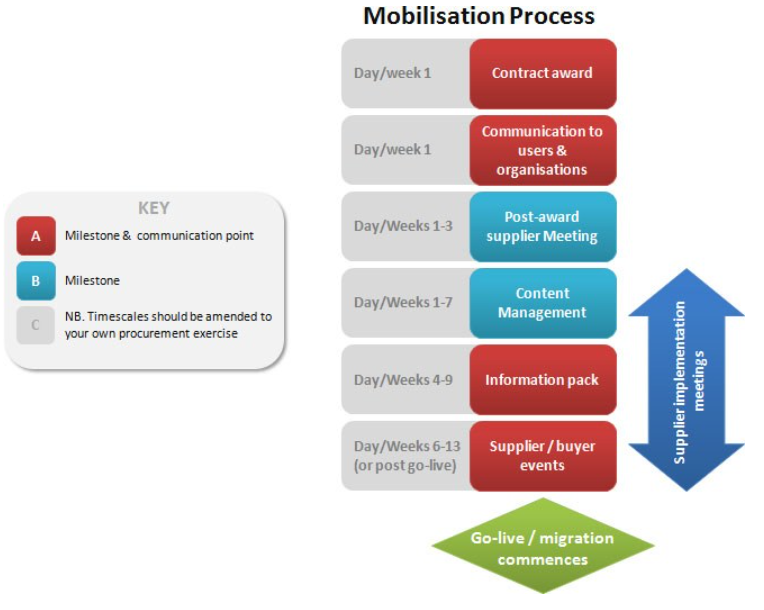
Contract and Supplier Management Introduction

Route 2 medium/high-value, medium/high-risk contracts make up a significant proportion of the Scottish public sector’s commercial activity. While they do not carry the same level of complexity or financial exposure as high-risk contracts, they are essential to the effective delivery of services, support organisational objectives, and represent a substantial cumulative spend across public bodies. Effective management of these contracts helps ensure value for money, service reliability, and compliance with procurement and governance requirements.

This guidance provides a practical and proportionate framework for managing Route 2 contracts and the supplier relationships that support them. It is aligned with the Scottish Public Finance Manual (SPFM), Scottish Procurement Policy Handbook and recognised best-practice principles for Contract and Supplier Management (CSM) across the public sector.

Route 2 contracts benefit from structured but scalable oversight. They typically require regular performance monitoring, clear roles and responsibilities, documented communication routes, and a disciplined approach to issue and risk management. 

By applying a consistent management approach, Organisations can ensure:

  • Contract performance meets agreed standards and service levels
  • Risks are identified and controlled in a timely and proportional manner
  • Financial and commercial arrangements remain transparent and well-governed
  • Suppliers understand expectations and are supported to deliver continuous improvement
  • Social value, sustainability, and community benefit commitments are monitored and delivered
  • Contracts remain compliant with relevant Scottish procurement policy and legislation

This guidance sets out the processes, tools, and governance structures that support effective management throughout the contract life cycle - from mobilisation and day-to-day monitoring to performance reporting, change control,  contract closure and lessons learned. It is designed to be practical, scalable, and useful for contract managers, service leads, procurement professionals, and operational staff who play a role in managing medium-risk contracts.

Purpose of CSM

The purpose of Contract and Supplier Management is to work closely with suppliers and internal customers to:

  • minimise the total cost of ownership and
  • to maximise supply chain efficiencies

Contract and Supplier Management should result in ongoing benefits that will include contract procedure and process improvements; increased Procurement Function knowledge and experience; improved supplier capability and improved supplier relationships. All of these provide mutual benefits that can then be used to benefit future contracts for both buying and supplying organisations.  This can be done by:

RelationshipsDeveloping and managing constructive and transparent relationships with suppliers
ExecutionEnsuring the contract is successfully executed.  Includes meeting all special conditions relating to the performance of the contract which may cover economic, innovation-related, environmental, social or employment-related conditions
Value for MoneyMaximising value for money from suppliers and contracts
Monitoring and ImprovementProviding a formalised system of monitoring, managing and continuously improving the supplier and the Organisation’s performance against the contract
Roles and ResponsibilitiesEnsuring that all parties recognise and understand their contractual roles and responsibilities
ComplianceMonitoring overall compliance to Key Performance Indicators(KPIs) and Service Level Agreements.  Implementing improvement plans in the event of underperformance.  Leveraging supplier expertise in pursuit of cost and efficiency gains
Improved Benefitsrealising additional savings and benefits and sharing them appropriately
Supply ChainEffectively managing the prompt payment of the supply chain
InnovationProviding a focus for development of initiatives and innovations
Continuous ImprovementDriving continuous improvement
Lessons LearnedIdentifying lessons learned to inform future contract terms or strategies
EfficiencyDeveloping supplier relationships to maximise efficiency.  Collaborate towards common goals and reduce waste, environmental or social risks
Strategic GoalsSupport the achievement of strategic goals, such as attracting Community Benefits through the contract
Sustainable ProcurementMonitoring Sustainable Procurement benefits through the life of the contract and ensuring that targets are met
Community BenefitsMonitoring Community Benefits achieved vs anticipated
Best Practice SharingUsing the CSM process as a vehicle to share experiences across different contracts, so synergising opportunities and practices

Care should also be taken to manage risks to changes in contracts e.g. you may require to re-tender if there is a substantial modification.


Vision

Organisations should use the four quadrants of the balanced scorecard consistently . This  allows measurement of a supplier’s performance across all organisations and / or sectors who are using that supplier.

Contract and Supplier Management should:

  • ensure that the service/contract is delivered to the required standards
  • provides value for money;
  • proactively identify and manage any risks which may impact on a supplier’s service delivery / fulfilment of the contract requirements;
  • improve and develop contract and supplier performance across organisations, sectors and nationally. A consistent approach will maximise efficiencies and promote adding value across the supply base;
  • appropriately influence supplier activity and decisions, improving value for money, over and above cost savings;
  • ensure the contract is effectively administered, for example from a change management perspective.

You should frequently aim to improve your own and supply base performance by various techniques.

Benefits of CSM

Both you and the supplier should be motivated and enabled to deliver additional value.  This should be done within legal limits and, over and above that specified in the original contract, e.g. not simply extending the expenditure. The process should deliver benefits such as:

Routes of EngagementProvide formal routes of engagement at different levels of management.  This allows opportunities for improvement at senior levels
Supply CostsEnsure supply costs are contained and minimising, and that opportunities for improving cost effectiveness and efficiencies are explored and progressed e.g. packaging/delivery efficiencies, service level definition
Deliver Business NeedsProactively ensure that the business needs under the contract are defined and delivered.  Ensure both customer and supplier’s obligations are understood and managed.  Reduce reactive ‘incident resolution activity’ to minimise the cost of failure and of managing the relationship
Issue ResolutionPromote proactive issue resolution.  Ensure clear escalation paths exist within both organisations
StandardisationUse a standardised approach for a number of suppliers/customers.  This will embed operational efficiency, consistency and quality
ConsistencyLimit the number of people involved.  This ensures process consistency and communication.  It ensures the right people are involved in the right activities at the right time with the right information
ImprovementsEncourage the supplier to improve their product or service in ways which provide additional value to the customer and to future customers.  Promote efficiencies within both organisations which will develop the skills of the employees and help the supplier’s staff to deliver a better service

Continuous Improvement

There are a number of formal and informal continuous improvement methods.  These range from: full continuous improvement programmes; to organisational collaboration; and improved internal and external communication.

One of the key continuous improvement tools used in the Scottish Public Sector is the Procurement and Commercial Improvement Programme (PCIP).  This is designed to drive forward best practice and develop procurement activity and provides organisations with a means to benchmark their own activities against a suite of nationally agreed criteria

 Contract & Supplier Management can be considered successful when:

  • the arrangements for service delivery continue to be satisfactory to both parties, and the expected business benefits and value for money are being achieved or exceeded
  • the supplier is efficient, co-operative and responsive
  • the Organisation understands its obligations under the contract
  • there are no surprises
  • there are no disputes
  • professional and objective discussions over changes and issues are straightforward and easily managed
  • efficiencies are being realised
  • the Organisation’s procurement department contract and market knowledge improves, and benefits future contracts

Consideration must also be given to Planning, Sustainable Procurement and Risk Management throughout this stage of the Journey.

Contract Implementation

This section outlines the process and activities involved with implementing a new contract.  This ensures:

  • supplier(s) have all the information they require to plan user’s migration to the new contract
  • users have all the information they require  e.g. suppliers’ contact details, information on the goods/services available from the contract
  • continuity of supply

Contract implementation consists of two distinct phases:

Migration The movement of organisations to a new contract post "go-live".
Mobilisation The process of moving from contract award to "go-live" i.e. the point when a user can actually buy from the contract.

Note: Some steps in the process may be done at the same time.

The mobilisation process above is a guide to help plan activities between contract award and go live. The timescales for each of the stages should be amended to reflect your own specific procurement exercise.

Consideration must also be given to Planning, Sustainable Procurement and Risk Management throughout this stage of the Journey.


Communication

Below are the key considerations for communicating the contract.  These should be considered in your communications plan (this is intended as a guide rather than being prescriptive:

Why?

Having completed the procurement to the point of award it is essential that it be correctly communicated. Communication of the contract award and of the subsequent procedures is an important part of ensuring compliance.  It also maximises the planned benefit(s) from the procurement exercise.

Who?

You must know who you are targeting with your communications. During  strategy development you should have identified all key stakeholders from suppliers to end users. You should consider communications in terms of the three areas below, for each of the identified stakeholder groups.

What?

What is your communication about? Be clear on and decide your key and supporting messages. Ensure that the subject is appropriate for the correct audience (stakeholder group) and  the communication stays focused on the appropriate subject, what they need to know and what is expected of them.


When?

Plan and consider  your communications timings carefully, in line with the implementation process.  Your communications must

  • arrive in good time
  • allow  the audience to understand t the information
  • allow the audience to then act upon or respond within the timescales.

 Communication should take place at the start, throughout and at the end of the process..

How?

You must consider how you communicate to your audience.  This can be determined by the stakeholder audience you are targeting. You may also wish to consider (but not limited to):

  • Newsletters – stakeholder community
  • Intranet/internet article – public audience
  • e-zines – targeted group
  • e-mail – small targeted group
  • Roadshows – specific bidders or the general supplier community

Accessibility requirements of your audience and accessibility legislation should be considered.


Care and Support Services - Communication and Transitional Arrangements

Communication with people who use services and their carers

Having finalised and agreed the procurement plan, an organisation should communicate its intentions to people who use the services and also their carers/representatives. It is important that an organisation provides clear and unambiguous information at this stage and that this information is tailored to the particular audience.

In these communications an organisation should explain:

  • how long it will take to decide who will provide the service;

  • what will happen at different times in the process;

  • how people who use the services and their carers will be involved in the process;

  • who will make the final decisions and how these will be made;

  • (where appropriate) why there may be a change in service provider; and,

  • how service provision may change as a result of the procurement process.

An organisation should also provide contact details for further information.

An organisation should ensure that people who use services and also their carers have help to understand the process and what, if anything, they are being asked about. It should also ensure that these people have sufficient time to consider how they might be affected and to formulate their views before having to respond

Transitional Arrangements

It is important that this stage of the procurement process is managed successfully to ensure minimum disruption to people who use services and their carers. This will require close co-operation between different teams within an organisation and between it and service providers.

This is particularly important where the outcome of the procurement exercise involves the transfer of an existing service to a new service provider. This is because there is some potential for the transfer process to be demanding and consume significant amounts of staff time. An organisation should facilitate the transfer of accurate, up to date information to the new service provider and ensure that the handover arrangements are appropriate and fully implemented.

Service providers will need to satisfy the Care Inspectorate that it can adhere to the Public Services Reform (Scotland) Act 2010 and Regulations and also meet the relevant National Care Standards. The Care Inspectorate can take up to approximately six months to register a new care service. This depends on a range of issues, including provision of a competent application and the complexity of the service being provided.

Where an existing service provider seeks to deliver a new service under the existing registered care services, this should be discussed with the Care Inspectorate. It may be possible to vary the registration to include the new contract. However, consideration would need to be given to: the current conditions of registration; the size of the service; management and staff support arrangements; geography; client group and needs of those people who use the services; transferability of staff across the service; staff skills and training; and the aims and objectives of the service.

If a service provider applies to cancel its registration, it is legally required to state whether notice has been given to those people who use the services and their carers about the changes to its service and how their needs will be met if the application to cancel is approved by the Care Inspectorate. An organisation should provide the necessary support and information to a service provider to enable it to meet its legal obligations.

An organisation which is outsourcing a service or bringing a service back in-house will have to meet its legal obligations under the TUPE Regulations. It should, in all such cases, seek legal advice on application of the TUPE Regulations. In other cases involving the transfer of an existing service, an organisation should consider whether it needs to take any action, for example to facilitate the exchange of information between service providers, should the TUPE Regulations apply.

Post Award Supplier Meeting

The first meeting with the successful supplier should be held as soon as possible after contract award.

The purpose of this meeting is to:

  • discuss the contract implementation phase
  • agree roles and responsibilities,
  • identify activities
  • agree timescales.

You must keep in regular contact with the supplier during the contract implementation phase, scheduling additional meetings and communications as required.

Content Management

If your commodity/service is deemed catalogue able you should set up the successful tenderer on the Pecos Content Management (PCM) system.  This ensures you can prepare the catalogues.

PCM will not be appropriate for Care and Support Services.

The process of content management from start to finish can take weeks.  It is mainly dependent on the size (number of line items) and number of catalogues involved.  This process involves:

  • receiving initial catalogue data from suppliers

  • checking catalogue content

  • validation checks and clarifications

  • testing (of data and systems used)

  • training (internally and of stakeholders)

  • communications (internally and to stakeholders)

  • issue catalogues to end user organisations. 

  • ongoing data checks, updates and system upgrades (following the above stages)

It is essential to allow enough time  for the completion of the above prior to the contract or framework go live.

Buyer/End User Information Packs

You may wish to create an information pack for organisations and/or users which contains key contract information including:

  • details of the contract goods and services available
  • contract prices
  • supplier contact details
  • ordering information
  • returns and delivery processes
  • complaints process
  • escalation process
  • contract and supplier management process

This information pack should demonstrate how the contract delivers best value and provides information  on contract benefits e.g. savings, KPIs, improvements in quality and service, prompt payment of the full supply chain, sustainable procurement and community benefits expected, etc.

An example of an information pack is provided in the Postal Services End User Guide example below. This is a detailed example.  Every information pack must be proportionate to the size and complexity of the procurement, therefore your information pack may be much smaller.

Supplier/Buyer Events

A useful way to raise awareness of the contract amongst potential customers is to organise Supplier/Buyer events to give both parties an opportunity to meet each other.  An example of the presentation can be found in the Contract Implementation Slides.

This is also a good opportunity to distribute information packs/ buyers' guides.

Postal Services End User Guide Example