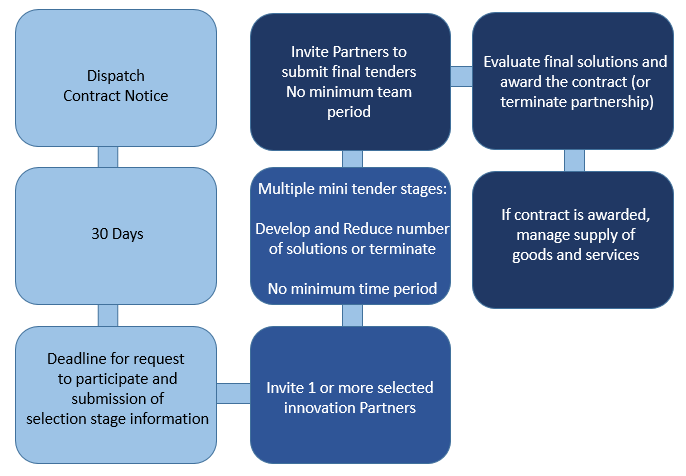
Procurement Routes
The procurement procedures available for you to use are as follows:
A commodity/service strategy should not be confused with a Procurement Strategy.
Further information on Procurement Strategy requirements can be found in the Additional Resources.
A commodity/service strategy is effectively a purchasing plan for a particular good or service i.e. it documents your sourcing strategy.
Key components of a commodity/service strategy with the suggested minimum requirements are included in the document section below.
Further information on Procurement Strategy requirements can be found in the Additional Resources dropdown.
If your procurement includes both goods and services your approach should be determined by the main subject of the contract. For example if the services/goods subject split is 60%/40% respectively by estimated value then the entire exercise should be treated as a services procurement exercise.
If your contract consists:
then the main subject of the contract is determined by which of the services or goods has the highest estimated value.
(Please note: the Procurement Journey does not cover procurements which are works contracts or contracts that include ‘utility’ activities e.g. running tramways. This includes works/utilities contracts whose elements:
Please consider Strategic and Public Social Partnerships; further information is provided below.
Additional guidance on determining the type and duration of the contract, and on transitional arrangements can be found in the Care and Support Services Contract Type, Duration and Transitional Arrangements.
As with other stages of a procurement exercise, you must consider conflicts of interest and fraud as part of the Commodity/service strategy stage. This must be in line with relevant procurement legislation and your Organisation’s own governance procedures.
You must ensure that you take all appropriate measures to prevent, identify and remedy conflicts of interest. You must include measures to combat fraud throughout your procurement exercise.
Your Organisation may seek a long-term strategic partner or partners e.g. for a period of 10 or 20 years. This may be to redesign and achieve major changes in service delivery and/or the use of resources.
For example, your Organisation may work with a supplier(s) to determine what range of services could be provided within available resources. This would be instead of tendering for particular services. In this situation, the choice of strategic partner(s) should be transparent and through a competitive process in accordance with the public procurement rules.
PSPs are strategic partnering arrangements. These are based on a co-planning approach where the public sector can work with third sector organisations. In such cases you would share responsibility for designing services based around service user needs.
The Scottish Government has published guidance on developing and running Public-Social Partnerships..
A PSP typically comprises three stages:
You should also consider the current and possible future relationships between the Public Body and the Supplier. You should demonstrate how you intend to develop any relationship with a potential supplier going forward.
If you are entering a joint procurement exercise with one or more public sector organisations, you must agree the legal status and requirements of such an exercise at this stage.
You Organisation may either:
In either of the above cases, the organisations are jointly responsible for ensuring they comply with all relevant procurement legislation.
Sometimes you could consider having only part of the procurement operating as a joint exercise. In such cases the organisations would be equally responsible for any joint areas. and retain sole responsibility for their own areas.
Other practical areas to consider and plan at this stage include:
Having considered the previous points you can identify the position of your commodity/service as either Leverage, Strategic, Routine or Bottleneck. The Strategic Positioning Action Plan provides guidance as to the procurement approach you should adopt in each of these circumstances.
These suggested approaches provide a starting point on how to proceed with your commodity/service. You must define these further still by looking at your specific commodity/service and the opportunities already identified using the Best Value Triangle.
There are many characteristics to Best Value that public service organisations are expected to demonstrate. Some relating to procurement are as follows:
In line with Statutory Guidance before starting your procurement you should consider whether Fair Work Practices are relevant and proportionate. If so, you should include a question/questions on Fair Work, to be evaluated along with other relevant criteria. Your question(s) should be informed by the results of your pre-market engagement.
In line with Statutory Guidance, published under the Act, you should consider including a statement in your strategy outlining your commitment to implementing Fair Work First. The statement should highlight a range of approaches that you may use to promote Fair Work First. That strategy must include a statement on your general policy on the payment of a living wage to those delivering contracts where the value of your regulated contracts in a year will be equal to or greater than £5,000,000.
By reporting and monitoring the delivery of intended sustainable outcomes, such as Fair Work First, you can more easily demonstrate how you are complying with the Sustainable Procurement Duty.
Organisations must determine if data processing activities are relevant to the commodity/service which is the subject of the procurement exercise.
Organisations must ensure that current and future procurement exercises (including contracts entered into before the legislation came into force) are compliant with GDPR and all relevant procurement documents make reference to the new legislation.
More detailed information on GDPR can found in Leadership & Governance.
Cyber Risks
If the contract will involve, support or rely on the digital processing of information, organisations should ensure that appropriate consideration is given to potential cyber risks and their management.
Further information on how to assess and manage cyber risks as part of the procurement process can be found in the Scottish public sector Guidance Note on Supplier Cyber Security. Buyers should assess cyber risks and develop minimum cyber security requirements as part of award criteria, if necessary.
Organisations must consider how their procurement processes can facilitate the involvement of SMEs, third sector bodies and supported businesses. These suppliers may have characteristics that give them competitive advantages over larger organisations which may include:
You should consider how you will ensure compliance to the contract.
Compliance is required from all parties throughout the whole Procurement Journey. Governance arrangements, management and budget holder behaviours are key to ensuring compliance.
The Components of a Compliance Strategy document should encourage maximum uptake of a new contract. Members of the User Intelligence Group (UIG) should champion the contract. Commitment from users should be obtained for the proposed strategy options.
There will be a number of potential options which are applicable to any commodity/service. These will vary with the type, size and complexity of the requirement.
In all cases, you should consider a 'Do Nothing' option as a benchmark.
The Commodity/Service strategy should include a summary of options that clearly details the:
associated with each option. These should demonstrate compliance with any legal obligations. This should help the selection of the required Commodity/Service Strategy option to be pursued in the short, medium and long term.
Estimated benefits within a commodity/service area can be obtained from sources such as:
Identification and assessment of “softer” benefits should be undertaken at this stage.
Costs to implement sourcing strategies include:
The Options Appraisal summarises the various delivery options, considering the benefits and risks of each before selecting an option for recommendation.
The recommended option must satisfactorily meet the requirements, be affordable, viable and agreed with the UIG.
You must consider awarding your contract in separate lots. Division into lots can increase SME participation.
Where you decide not to award a contract in the form of lots, you must indicate the main reasons for not doing so. These reasons must be included in the relevant Procurement Documents, or in the procurement exercise written report.
Potential reasons for not subdividing contracts into lots may be:
You must state in the relevant Procurement Documents, whether bids may be submitted for one, for several or for all lots. Where more than one lot may be awarded to the same bidder contracts may be awarded that combine several or all lots. You must have specified this can happen and include the groups of lots that may be combined. If you use this approach, you must think carefully about how the relevant evaluation matrices will assess all possible scenarios.
You can limit the number of lots that any one bidder can win. To do so you must state the maximum number of lots per bidder in the relevant Procurement Documents.
During the Profiling the Commodity stage of your procurement exercise, you should have considered whether bidders may sub-contract any of the awarded works or services. If so, question 4.C.4 from the SPD should be included to be evaluated alongside other criteria at selection stage.
Confirmation of how bidders will ensure payment of sub-contractors at all stages of the supply chain pertaining to the contract, within the standard 30 day payment terms and how this will be managed should be evaluated at award stage.
There are separate stops on the Procurement Journey on Contract Mobilisation and Implementation and Contract and Supplier Management (C&SM).Your approach must be considered during this 'Develop Commodity/Service Strategy' phase.
You must consider how the proposed options will operate throughout the life of the requirement. For example, if you decide to use an existing contract or framework agreement the contract implementation and management will be covered in the framework terms and conditions. These must be complied with in full.
You must think about how the new goods or services will be introduced into your organisation. Also how will you move from your existing arrangements to the new arrangements?
You should also consider your transition or exit strategy for when this new contract or framework agreement comes to an end.
Once fully operational you should manage and develop the contract and supplier(s) to ensure the contract requirements are met now, and in the future.
You must consider the resources required to implement and manage the contract or framework agreement. A designated contract manager should be identified. Additional guidance can be found in the Planning & Governance station.
You should detail the CSM requirements in the contract or framework agreement terms and conditions. This will ensure both parties are clear on their contractual obligations. The contract should then be managed in accordance with these terms and conditions.
The level of CSM required depends on the risk, value and complexity of the contract. You will find guidance to help assess the potential level management of CSM required in the Contract and Supplier Management / Planning and Governance station.
Generally, "Routine" contracts will require a lower level of management than "Leverage" and "Bottleneck" (medium level), and "Strategic" which will require the highest level.
There may be opportunities for your organisation to make its own internal processes more efficient. Some of the key areas to consider during the procurement process are:
Further guidance can be found in the Planning & Governance station.
As with all aspects of the Procurement Journey, the activities at this stage must be carried out in a carefully managed manner that supports the Principles of Procurement.
(file type: docx)
(file type: docx)
(file type: doc)
(file type: doc)
(file type: docx)
(file type: ppt)
You will now identify high-level opportunities. This will be based on data gathered in the previous stages, which may be achieved with or without creating a new contract.
Strategic sourcing highlights opportunities in three key areas:
The above are portrayed as the three sides of the 'Best Value Triangle', which can be found at the bottom of the page.
Your commodity/service team should assess and highlight the potential opportunities on the triangle that could be further developed. The team should determine how they could be applied to the commodity/service in question. Risk should always be considered.
Your assessment of high-level opportunities should be carried out using the Sustainable Procurement Test, which can be found on the Sustainable Procurement Tools Platform.
The Best Value Triangle, available in both in graphic and table format, can be found at the bottom of the page.
You must also include any economic, social and environmental, and sustainable procurement opportunities in your strategy e.g. include community benefits and Fair Work Practices.
This exercise should be proportionate to the complexity of your requirement. You are not expected to address every aspect of the best value triangle.
Quickfire Guide
Early opportunities are defined as cost savings, sustainable procurement opportunities or total cost improvements which:
There are many factors to consider for implementation of all opportunities as well as early opportunities:
The Opportunity Assessment Template is an aid to quantifying and prioritising the opportunities which will be included in the commodity strategy.
(file type: docx)
(file type: docx)
You should ensure all research conducted is collated and reviewed as a whole. A poorly scoped and researched requirement can present major risks to the project. Records should be kept of any discussions with potential suppliers.
The following areas are key:
Checklist
| Cost | Included? |
| Small/short term funding and larger/long-term funding | |
| Whole life costs including set up, running and decommissioning costs | |
| The cost of meeting all regulatory requirements | |
| Additional costs related to location e.g. rural location results in extra transport costs, import/export taxes, etc. | |
| The complexity of the service | |
| Training and continuing development of staff | |
| Potential costs of staff transfers under TUPE regulations | |
| Additional costs of inflation, and | |
| Any commitments to three year funding cycles (or longer) where appropriate | |
Blank rows are provided for your use e.g. to add additional checklist items.
An organisation should also:
For additional guidance for Care and Support Services see Benefits and Risks to People who use Services and Service Delivery below.
(file type: docx)
You should undertake supply market analysis to allow the User Intelligence Groups (UIG) to develop a detailed understanding of:
that could influence the development of the commodity/service strategy e.g. route to market, strategy concerning the use of lots. At least one of the market analysis templates provided should be used to assist in this exercise. You should read the guidance below prior to completing the templates.
At the end of the analysis you should provide a summary of your findings. The Market Summary Template may assist you with developing your own Market Summary.
Once you have completed your Commodity Tree or Options Appraisal and Supply Market Analysis, this information will support grouping your requirements into suitable lots. For example for a waste equipment disposal category you may choose to procure plastic and metal bins through separate lots.
You should give consideration to the potential for third sector involvement and supported businesses and SMEs.
If you are not using lots in your procurement exercise you must provide the main reasons for this in:
You should consider:
The public sector equality duty is set out in the Equality Act 2010. It requires organisations to assess the impacts of new or revised policies and practices on people with different protected characteristics. To do so you need to consider the three needs of the public sector equality duty i.e.:
The protected characteristics are:
|
age |
disability |
gender reassignment |
marriage and civil partnership |
|
pregnancy and maternity |
race |
religion or belief |
sex and sexual orientation |
An organisation must also consider the need to undertake and publish an Equality impact Assessment (EQIA). Depending on your particular procurement, an EQIA may be an integral part of the procurement process. It should help identify and mitigate negative impacts and identify opportunities to promote equality. This can be done by looking at how your procurement might impact on people with a protected characteristic. For example for the service industry, which relies heavily on its labour force, an EQIA may help to identify new or improved ways or working.
The supply market sources document at the bottom of this page is a list of suggested external sources for supply market data. This may provide you with useful information required to develop your commodity/service strategies.
Please note that you may require a licence or there may be a fee to use some of these sources.
For future reference, make a note of the sources consulted in a external data sources template. Your use of external data should be appropriately referenced throughout the process.
Although we have detailed external websites or publications, this is not a Scottish Government endorsement.
The overarching theme of early engagement is to identify the desired outcomes, risks and issues and permit potential suppliers to provide feedback on how the outcomes might be achieved, the risks and issues as they see them, along with feedback on timescales, feasibility and affordability. All discussions should flow from this theme.
Any cost discussions you have at this stage should be indicative only. You should make this clear to potential bidders.
Care should be taken to preserve transparency and equal treatment.
Frequently it is more appropriate to ask the market what solutions are currently or potentially available prior to advertising a contract. This is explained further in the ‘Stakeholder Identification’ and Preliminary Market Consultation stations). The Public Contracts (Scotland) Regulations 2015 (Regulation 41) now include provision for Organisations to engage in market consultation.
Any such market consultation must be carried out in a carefully managed manner. This must comply with the Principles of Procurement.
Market consultation can encourage bidders' creativity in their potential solutions. This can inform your decisions on when and how to procure the best available solution(s).
Market sounding can be beneficial as a long-term strategy, even when you do not intend to carry out your procurement exercise soon. As a matter of courtesy you should be transparent with suppliers about this.
There is no formal process for market sounding. Activities typically include researching and analysing the whole market and meeting selected potential suppliers for discussion. Your Organisation must ensure that it takes appropriate measures to ensure that competition is not distorted by the participation of potential suppliers.
You can generate supplier interest by publishing advance notice of your likely requirements, for example through a Prior Information Notice (PIN) in Public Contracts Scotland (PCS).
Organisations should engage with a cross-section of potential suppliers. This will inform your strategic options i.e. the views of a Small and Medium sized Enterprise (SME) compared with a large or multi-national supplier may differ.
Market sounding improves public sector knowledge that is useful in a broader sense. For example UIGs greater understanding of relevant markets helps to develop their commodity/service strategy. This could be in terms of how they currently operate and how they may operate in the future i.e. changing technology, market entrants etc..
Early engagement with potential suppliers can be critical to success. It is vital to understand key issues before starting the procurement process. You should determine your desired outcomes, risks and issues and allow potential bidders to provide feedback. For example on how the outcomes might be achieved, along with feedback on timescales, feasibility and affordability.
You should always be present at meetings with potential bidders. A bidder who understands your requirements and can offer innovative solutions and constructive advice should be present. The right attitudes must be adopted: respecting confidentiality, maintaining flexibility and openness.
When procuring a service, you should also consider your organisation’s policy and approach to delivering services in-house.
In respect of the above questions and the following areas of guidance, you should consider specific stakeholder engagement activity and management. For example:
It is important to tie this into your stakeholder mapping exercises.
You must document the measures taken to ensure competition is not distorted during any prior involvement of candidates or bidders.
Talking to potential suppliers is at the core of market sounding. It is crucial to talk to the relevant potential suppliers - ideally, those who have achieved outcomes of a similar nature and scale.
Care must be taken to ensure those contacted are not given an advantage over other potential suppliers. It is equally important to ensure specifications are not written in such a way as to favour any particular potential supplier(s). If either of these approaches is not adhered to you could breach the Public Contracts (Scotland) Regulations 2015 and the procurement itself could be challenged.
Measures to ensure competition is not distorted must include:
There are a number of questions you can ask to support you market analysis. This Quickfire Guide list some examples.
Community benefit requirements may not always be appropriate to your contract. You must consider their use by taking into account the nature of the contract, its duration and other factors.
Care should be taken to ensure the requirements would not place a disproportionate burden on potential suppliers or have a wider negative unintended effect. This could be the case, for example, where training and recruitment requirements are included. Here, care needs to be taken to avoid displacement of existing trainees and employees in order to meet community benefit commitments. It should also be noted that training and employment opportunities require adequate contract length for these activities to be undertaken.
What Dimensions of Fair Work Practices can be Targeted?
Sustainability: can potential suppliers provide solutions to sustainability issues?
The purpose of analysing the market, is to take into account in more detail the external and internal factors affecting the commodity/service and supply. The various tools below can help you in this activity. The results should lead to the identification of opportunities and risks which will inform strategic options to consider.
Not every template listed in 1-7 below requires completion. You should consider the complexity of your commodity/service and procurement exercise to help you decide which template(s) to use. Once your analysis is complete, consider how to use this information to inform strategic options.
All templates listed can be found under "Any documents you need are listed below" at the bottom of this page.
1. Supplier profile analysis
The supplier profile analysis tool can be used to paint a picture of the main players in the market.
2. Competitive advantage - Porter's 5 forces
Porter's 5 forces constitutes a framework which demonstrates buyers/suppliers' relative power in the market place.
3. SWOT analysis
The SWOT Analysis examines environmental factors internal to the organisation (usually classified as Strengths or Weaknesses), and those external to the organisation (classified as Opportunities or Threats).
4. PESTLEE analysis
The PESTLEE analysis assesses the external environment which may have an impact on your requirement.
5. Supplier market share
The supplier market share provides an insight into the positioning of the main players within the market. Factors such as industry attractiveness, competitive pressure and degree of market concentration/fragmentation.
6. Understanding supplier cost drivers
The supplier cost drivers document provides:
7. Total cost of ownership
Total Cost of Ownership (TCO) is the initial acquisition cost plus ownership/operation and disposal costs. Understanding this will help in identifying areas for improvement internally within the organisation and externally with potential suppliers. The following guidance document will help you to consider the wider costs associated with the procurement of the requirement.
It is possible that the potential supplier for a contract may be another public sector organisation. A contract between two or more such organisations may be exempt from the Public Contracts (Scotland) Regulations 2015 and the Procurement Reform (Scotland) Act 2014. This exemption is in place if the “buying organisation” and the “supplying organisation” are jointly controlled or if all of the following conditions are met:
(file type: docx)
(file type: docx)
(file type: docx)
(file type: docx)
(file type: docx)
(file type: docx)
(file type: doc)
(file type: docx)
(file type: ppt)
The purpose of this section is to:
You should start by breaking down the requirement into its sub-commodities/services and identify the specific products/services within each category.
Use one of the templates below to assist in this process:
Once you have identified the specific products and services it is important to consider their specific environmental or social characteristics.
You should use labels (if they exist in the marketplace) that comply with these characteristics e.g. those relating to fair trade. Please note, bidders should be allowed to offer other, appropriate means of proof.
You should also consider whether you should include special contractual conditions which relate to the performance of the contract. This may cover:
It is a legal requirement that each contract includes conditions which are reasonably necessary to ensure that the supplier(s) comply with environmental, social and labour laws. These conditions must be linked to the subject matter of the contract. These conditions of contract must be included in the procurement documents. At this stage you may wish to consider how the goods/services are ordered and invoiced e.g. electronic purchase orders, purchasing card, consolidated invoices and self-billing.
You should consider whether or not the commodity/service you are buying is capable of being catalogued or not.
This simple Guide to Making Content Decisions at the bottom of the Pecos Content Management page will guide the buyer in the right direction.
If the commodity/service you are buying is to be catalogued, this electronic content must be provided for in the contract via Pecos Content Management (PCM) .
Sometimes it is appropriate to build the ITT documents in a format where the evaluation is based on catalogue submission. If this is the case, the Contract Notice or the invitation to confirm interest as a result of a Prior Information Notice (PIN) should detail this clearly. Further guidance is provided at the notification of contract award decision and at the develop documents stages.
The key characteristics for each sub-commodity/service can now be identified and agreed by using the Key Commodity/Service Characteristics template.
Example of Care and Support Services Service Tree (Residential Care).
If your procurement is of a Digital or ICT nature, consideration must be given to the Digital Public Services Scotland Programme. This strategy sets out the collective ambitions and national level actions at sector, cluster or organisational level. Since this strategy was published more Current Standards, Guidelines and Recommendations have been developed as outlined within the ICT High Level Operating Model.
Further information on how to assess and manage cyber risks as part of the procurement process, including Guidance Note on Supplier Cyber Security.
The Sustainable Procurement Duty, outlined in the Procurement Reform (Scotland) Act 2014, requires you to think about how you can:
Creating a positive impact through procurement should be a key part of commodity/service profiling and strategy development. Embedding sustainability into procurement can support the objectives of the organisation as set out in relevant policies and/or strategies and can be adapted to reflect the nature of the contract.
The scope to achieve sustainability benefits can be aided by supplier and market engagement before the procurement process begins which is essential to allow understanding of the market capability and for the market to understand and prepare their response to tender requirements. You should fully explore the possibilities with your User Intelligence Group and other relevant experts for your procurement.
Quickfire Guide
|
Economic Factors
|
Social Factors
|
|
Health Factors
|
Environmental Factors
|
When considering sustainable procurement outcomes (such as above), any contract requirements must be linked to the contract subject matter.
Statutory Guidance has been published on the Sustainable Procurement Duty to help you.
The Scottish Government has developed a number of tools to help you:
You can use the following tools when developing your commodity/service strategies:
Life-Cycle Impact Mapping: Every product and service has a 'life cycle' or number of stages it goes through:
Life cycle impact mapping (LCIM) is used to identify and assess the social and environmental impacts of these stages.
The Sustainability Test: used at category/commodity/service level to identify potential scope of benefits.
The above tools can be accessed by registering on the Sustainable Procurement Tools platform. Accompanying Sustainable Procurement Guidance can also be accessed on the Sustainable Procurement Tools and is available for both registered and unregistered users.
By using these tools you can:
There are always different options available to you when examining how to achieve this balance. You may wish to visit the Case Studies section of the Sustainable Procurement Tools platform to read process-focused examples of how sustainable procurement benefits have been embedded in public procurement exercises.
Risks and opportunities from sustainable procurement are aligned with the National Outcomes and the UN Sustainable Development Goals.
To meet your obligations under the Sustainable Procurement Duty you must consider how to facilitate the involvement of:
in all procurement exercises.
To do so there are some specific actions you must take:
SME’s
The majority of businesses are SME’s. By doing everything you can to make it easy for SME’s to bid for your exercise then you are reaching the broader market and this can benefit your organisation as well as the broader economy.
Some things you can do to help SME’s access public procurement include:
There are many more things that you can do (or indeed not do), and you should take time to explore these as part of your strategy development. Speaking to colleagues, your UIG and contacting organisations such as the Supplier Development Programme can be very helpful.
Third Sector
The Third Sector, which includes charities, social enterprises and voluntary groups, delivers essential services, helps to improve people’s wellbeing and contributes to economic growth. It plays a vital role in supporting communities at a local level. The economic contribution of Third Sector organisations is steadily increasing and we expect this to continue in the coming years. Some things you should do to help Third Sector suppliers access your procurement exercise include:
Many of the actions that you can take to make sure SME’s are engaged can also support the inclusion of Third Sector organisations. Each local authority in Scotland has a “Third Sector Interface” (TSI) and further information can be obtained from them if you need help in identifying local Third Sector organisations.
Reserving Contracts for Supported Businesses
SPPN 1/2025 provides further information and guidance on Reserving Contracts for Supported Businesses, including:
Fair Work practices are actions an employer adopts for the benefit of its workers. They are above the minimum legal requirements and reflect the five dimensions of the Fair Work Framework.
When developing any procurement exercise, you must do so in line with Statutory Guidance. This requires you to consider how to address Fair Work practices in all procurement exercises before you start your procurement.
To support this Best Practice Guidance and a Toolkit have been developed to offer additional guidance and practical tools for public bodies and suppliers. Guidance has been embedded throughout the Procurement Journey.
The Scottish Government believes that contractors who go beyond minimum legal requirements by adopting Fair Work practices will:
positively impact on the delivery of a public contract. The payment of the real Living Wage is considered by the Scottish Government to be a significant indicator of an employer’s commitment to Fair Work practices. The payment of the real Living Wage is one of the clearest ways an employer can demonstrate a positive approach to its workforce.
The Scottish Government expects:
In addition to the Sustainable Procurement tools, a Fair Work practices commodity/service strategy: checklist and flowchart is available to help identify how to address fair Work in relevant procurement exercises with an example - Fair Work commodity/service strategy: checklist - home support services.
The Toolkit also includes Information Sheets on:
You must make sure the performance of the contract by suppliers complies with their obligations in environmental, social and labour law. It is essential that robust requirements are built into your strategy, procurement documents and contract management processes.
SPPN 09/2016 includes guidance and contract conditions an organisation can adapt for use in its contracts.
You must consider how you can promote innovation through your procurement exercise.
Some methods you can use to achieve this are:
You may find SPPN 3/2023 to be helpful when considering how to support innovation through procurement.
Sustainable procurement elements can also be included as part of your costing model and it’s important for you to review what models are available and assess where you think that sustainable elements can be considered.
You can apply life cycle costing as part of the specification and subsequent evaluation.
Life Cycle Costing may be used where additional environmental costs result from the products or services being purchased e.g. carbon emission costs from purchased machinery and the environmental disposal cost at end of life.
Further information on whole life costing and life-cycle costing can be found in Additional Resources
Lifecycle Impact Mapping:
Focuses on social and environmental impact rather than cost. Life cycle impacts help the user identify and assess impacts. For example, it may help to focus attention on the disposal phase before the procurement is carried out. This allows you to build end-of-life management requirements into performance clauses for successful contractors and your own internal management procedures.
There is specific guidance around the use of labels within procurement.
To specify labels in your procurement exercise you need to meet the following criteria:
Rather than apply a label on a broad basis, if it’s more proportionate you can detail which label requirements are to be met. This will reduce the burden on bidders and could expand the number of capable bidders for your process.
Labels must comply with the label requirements of the Public Contracts (Scotland) Regulations 2015 and equivalent labels must be accepted. Where the bidder can demonstrate it has not been possible to obtain either the label or an equivalent, through no fault of its own, you must accept other appropriate means of proof e.g. manufacturers technical dossiers.
You should work with the User Intelligence Group (UIG) to review and understand the current contractual situation for the commodity/service to:
You should collate details of existing contract(s). This information could include:
You may wish to use the Current Contract Status Template to record this information.
You should work with your UIG to assess future demand for the commodity/service. The assessment would be based on team knowledge and expertise and information obtained from non-team members.
A detailed understanding of the current spend and future requirements, of participating organisations, are key to the commodity/service strategy development.
An organisation should determine what resources are available for delivery of the service.
Financial planning is essential to ensure that service specifications are realistic. This ensures the specified requirements and outcomes are informed by the organisation’s analysis and benchmarking of costs. This means delivery will be within the available budget.
An organisation should consider what funding it can commit to the delivery of a service and for what period of time.
An organisation should assess whether the service has met specified key performance indicators and other contractual requirements previously. It should seek feedback from people who use services and their carers and review other information relating to the quality of the service, including information from contract management and service review and information from the regulatory bodies, including any complaints about the service.
It is important to consider the Specific Considerations for CSS Contracts.
To assist with spend analysis, many Scottish public sector organisations can access information on historical commodity/service spend via The Hub. The Hub contains many pre-defined reports and data that can be exported into MS Excel format.
The Hub can be used to identify possible transactional savings and collaborative opportunities.
Some suggested areas for analysis are:
The Spend Analysis Example, generated using information from The Hub can be found in the additional documents section below.
The data in The Hub is not at line-item level . This means that detailed spend information will still need to be obtained from suppliers, or where available, from purchase order systems.
It is good practice to ensure suppliers are contractually required to provide line item spend details as part of the contract to support:
In addition to Spend Analysis, an organisation should review existing delivery arrangements for a service with a view to:
Evaluating existing arrangements for delivering the service against best value principles will require an organisation to consider:
The Public Contracts Scotland (PCS) Contracts Register module provides the facility for buying organisations to operate a private register of all contracts they have in place and a public register of these contracts to meet the obligations of Section 35 of the Procurement Reform Act (Scotland) 2014.
Regulation 51(6) allows a contracting authority to withhold publication of information in the contract award or the conclusion of the framework agreement. This is where the release of the information:
(a) would affect law enforcement or go against the public interest;
(b) would prejudice the commercial interests of any person;
(c) might prejudice fair competition between economic operators.
Be aware that even if you withhold the contract value from a contract award notice, this does not exempt the information being subsequently disclosed under the Freedom Of Information (Scotland) Act 2002 (FOISA). FOISA thresholds are higher i.e. - to withhold under FOISA, the information would have to, or be likely to cause substantial prejudice. Also the public interest in withholding the information would have to outweigh the public interest in its release.
Detailed contracts register user guidance can be found in PCS.
PLEASE NOTE: if you do not use PCS for producing a contract register, you still must produce a publicly available one.
(file type: docx)
(file type: docx)
(file type: docx)
(file type: docx)
Quickfire Guide
Whole life costs;
Quality;
Meet the end user(s) requirement;
Identify any current contracts in existence;
Estimate the relative spend on the goods/services in question;
Use a sustainability test to maximise the positive impact the procurement process can provide. This is in terms of social, economic and environmental impacts;
Where the contract value is estimated to be equal to or greater than £4,000,000, would you impose community benefit requirements as part of the procurement?
Consider Commodity/Service Characteristics (does not apply to Care and Support Services);
Consider how relevant Fair Work practices are to the scope of requirements (including Sub Contract requirements where relevant). Ensure inclusion in accordance with the Statutory Guidance on Addressing Fair Work Practices, including the Living Wage, in Procurement. The Practical tools are included there to help inform your decision e.g. – Fair Work commodity / service strategy – "Checklist“ and “Flowchart“ will help inform your decision;
Consider any cyber risks, with reference to the Scottish public sector Guidance Note on Supplier Cyber Security
Consider how relevant Rights of the Child provisions are to the scope of requirements. Ensure inclusion when relevant and proportionate in accordance with UNCRC guidance;
Assess the current state of the market;
Identify market key players who could meet the requirements;
Assess the current market for opportunities. For example such as the purchase of supplies or services labelled or certified as having specific environmental, social or other characteristics (e.g. fairly traded or equivalent);
Understand current and future needs of the participating market organisation(s). Include this in your approach to market;
Identify any early opportunities to explore. Provide options for meeting these requirements;
Identify any special conditions relating to the performance of the contract. For example economic, innovation-related, environmental, social or employment-related conditions, that should be included in the contract. These can be included as long as they are linked to the contract subject matter and proportionate.
When developing a service strategy, an organisation must decide how the service will be put in place and develop the service specification. An organisation should consider service characteristics and develop a procurement plan which describes:
As a matter of best practice an organisation should have a local commissioning strategy and/or service(s) plan which establishes strategic and individual needs and determines what type of service should be put in place to meet those needs and deliver the intended outcomes. An organisation should ensure that there is clarity about:
An organisation should analyse the benefits and risks to people who use services, and also to service delivery, of advertising the requirement and awarding the contract or framework agreement by competition. For existing services, this will require consideration, through consultation with people who use services and their carers, of the impact that any change in service provision of supplier will have on:
This analysis may suggest that, where an organisation is satisfied with the quality of a service and that best value is being achieved, the existing supplier should continue to deliver the service. If an organisation's contract with the existing supplier includes an extension option that is within scope, the contract may be extended for the specified period. In the absence of an extension option, any decision by an organisation to renew (or "roll forward") its contract with the existing supplier must be compliant with public procurement legislation. Legal advice should always be sought in respect of any procurement decisions.
Alternatively, the analysis may suggest that the requirement should not be advertised at the current time and that a staged approach should instead be adopted. If an organisation decides to adopt a different timetable for advertising the requirement, it should describe this in relevant procurement documents and set out how it intends to move towards competition in the future.
An organisation should assess the risk of legal challenge if it decides not to advertise the requirement and proceeds to award the contract or framework agreement without competition. A legal challenge may have serious implications for procurement activity and future service delivery. For example, for a "light touch" contract with a value of at least £663,540 such a challenge would be pursued as a commercial action.
If your procurement is Digital or ICT in nature, consideration must be given to the Digital Public Services Scotland Programme. This strategy sets out the ambitions and actions at sector, cluster or organisational level.
Further standards and guidelines can be found in the ICT High Level Operating Model and the Digital First Service Standard.
The activities at this stage must be carefully managed and comply with the Principles of Procurement in The Public Contracts (Scotland) Regulations 2015. The processes must be undertaken in a transparent and proportionate way. This will ensure no market distortion, treating bidders equally and without discrimination. The procurement outcome unduly favour or disadvantage a particular bidder. It is the responsibility of the Organisation to make sure these requirements are met.
(file type: docx)
A stakeholder is an individual or group who have an interest or concern in something e.g. an activity or a business.
When undertaking aprocurement exercise it is crucial you ensure that stakeholders are involved to:
For procurement exercises, a User Intelligence Group (UIG) should be created. The UIG is a cross functional team containing key stakeholders.
This group should have representation from key stakeholders within the participating Organisation(s). Members should include procurement and business/technical/customer representatives.
The National Standards for Community Engagement principles may help when establishing the UIG. These principles are designed to support and inform the process of community engagement and improve outputs.
All UIG’s should have a minimum of two members i.e. the Buyer and the end user.
All UIG’s (with the exception of Care and Support Services) should have a minimum of two members i.e. the Buyer and the end user
Quickfire Guide
You should undertake appropriate research before the first UIG meeting. For example:
This research will help you gain an initial understanding of:
At this stage, consideration should also be given to the sustainable procurement factors to be built into your process. You can also identify any expert or informed input that will be required e.g. guidance from climate change experts on carbon in the specific supply chain, or input from Economic Development officers regarding employment opportunities.
The benefits of establishing a UIG are:
Stakeholders should work to:
Where there are a large number of stakeholders, for example a collaborative contract, it may not be possible to have all stakeholders represented on the UIG.
Stakeholder mapping is a useful tool to help identify who should be represented. This is based upon their likely impact upon the success of the project.
You must also ensure you understand your Organisation's policy or requirements regarding engaging with end users/customers of the commodity or service and whether they should also be involved in the UIG.
Depending on the specifics of the procurement exercise, the Buyer may ask stakeholders the following questions prior to the starting their procurement:
For the procurement exercise to be effective, it must meet the reasonable expectations of stakeholders and end users.
A clear understanding of stakeholder and end users' views is essential. To obtain this understanding you must have effective stakeholder engagement, taking into account all stakeholder views.
Many stakeholders will be positive and supportive however, it is also important to understand the reasons why stakeholders may not be supportive.
In order to manage this you may wish to consider some of the following:
The stakeholder map is a useful tool for the UIG to plan communications to stakeholders who are not UIG members.
You may wish to issue the attached UIG Welcome Pack which covers:
A UIG charter should be agreed.
Members of the UIG should not underestimate the amount of time and commitment involved in being a member. Although the UIG may meet only fortnightly or monthly there will be work to be completed in between meetings. Members should come to meetings fully prepared.
A UIG Membership Template an be used to record UIG membership and contact details. Information can be found in the UIG Information and Templates below.
Stakeholders should:
Engaging the market provides an opportunity to ensure the services provided are at the forefront of those available. Market sounding should also take into account the knowledge held by others buying Organisations, trade bodies and business support Organisations e.g. Federation of Small Businesses and Chambers of Commerce etc.
Care should be taken to uphold the principles of transparency and equal treatment during such discussions. It is strongly recommended that market sounding activity is documented so that, if challenged, there is a record on file of what took place.
(file type: docx)
(file type: docx)
(file type: docx)
(file type: doc)
(file type: ppt)
(file type: ppt)